A thoughtful approach to lambing and a disciplined process throughout it has seen a marked improvement in flock performance at the Banff and Buchan Monitor Farm.
Monitor Farmer Bruce Irvine’s 400 mainly Highlander ewes lamb outside during the day, coming in at night, with vet students and family and friends assisting. His aim is to ensure the lambs’ immune system is never compromised, keeping them as healthy as possible so they perform well.
As a result, losses from scanning to weaning at Sauchentree, near Fraserburgh, have fallen significantly, from the Scottish flock average of 15% to less than 7%. Better lamb health has also meant they finished earlier with less supplementary feed; in the first year it was 10t less, saving more than £1,600.
A range of tactics have helped boost lamb survival and performance, with a team meeting at the start of lambing being a crucial part of the whole approach. That’s when vet consultant Tim Geraghty and farm vet Alison Taylor from Buchan Vets spend half a day with everyone involved in the lambing, discussing, demonstrating and getting lambers to practice key skills. It means everyone knows what needs to be done and how, with Bruce adding that team members are often more accepting of vet instructions than if he were to tell them.
Tim says there is a temptation to think everyone, and especially vet or agri students, will be familiar with lambing and tasks such as stomach tubing, but it’s not always the case.
He says: “It’s dangerous to assume everyone will know. You need to make it easy for people to say they are not 100% sure, and that they won’t be judged for saying that. Part of our time on the visit is spent ensuring everyone is confident about tasks such as stomach tubing, and to make it the default that everyone does it in the same way.”
The discussion also covers biosecurity and personal hygiene, as keeping wellies and clothing clean can make a massive difference, says Tim.
“It’s normal that on a mixed farm your wellies and leggings or overalls might be a bit dirty or muddy, but during lambing you are dealing with very high risk baby lambs who are trying to develop their immunity in a very busy area.
“Having clean hands, using gloves and having clean leggings can make a massive difference. Set the bar that the lambing shed will be a clean place. If you set out with clean leggings, you are likely to wash them down if you get some lamb skitter on them, but if you start with dirty leggings they usually just get dirtier and you are less likely to notice and can pose a huge infection risk.”
At Sauchentree, everyone power washes their leggings and boots four times a day, with disinfectant foot dips in every shed.
Bruce has also equipped his lambing sheds with a basic ‘lambing kitchen’ to make cleanliness easy. A sink, kettle and paper towels mean it’s quick and easy to clean equipment such as stomach tubes between every use. A working fridge also allows colostrum to be kept at the right temperature to avoid any bacterial growth which could negatively affect lambs.
“The lambing kitchen means we are not having to run to the house all the time. It makes doing things straightforward – it’s easy for folk to do the right thing.”
Last year he also stopped using one of his sheds for lambing, despite it being well equipped, choosing to instead move the operation into two adjacent sheds. “Our cows calve outside now, so we had a free shed and I was also fed-up of moving everything out of the other shed for lambing.
“It has made a big difference. I didn’t think about the distance at the time, but going between the sheds nine or 10 times a day just added to the tiredness.”
He has also started housing sick lambs and ewes in a separate building until they are better, which has stopped them spreading bugs to the healthy ewes and lambs.
Even so, Tim adds a cautionary note: “These poorly lambs will be excreting millions of bugs, and when you are nursing them, you have to be very aware of that, as you can very easily spread it. Your responsibility is to the whole flock, so even if you save one lamb, if you infect another 20 or 30 that is not a gain.
“Every time you kneel down in the sick lamb pen you will pick up their bugs, and can potentially carry them back to the main, healthy flock. It’s worth raising the awareness of how dangerous the sick and pet pens can be to other lambs.” Biosecurity and cleanliness between the main flock and these pens is critical, he says.
At Sauchentree, all pens are cleaned out and disinfected after every ewe. A spray disinfectant is applied to the wooden pens and floor via a garden hand pump, and a lime-based powder is spread on the floor before bedding down. Pens are bedded with wood shavings which also have some anti-bacterial effect, says Bruce. Shavings are bought in bales to make handling easy at lambing.
Bruce has also changed the watering system, with individual buckets being replaced with a piped system using drainpipes with holes cut in them. “It cost very little to do,” he says. This ensures ewes have fresh water at all times, and saves buckets being tipped or lambs getting stuck in them.
Ewes are offered a TMR mix as soon as they have lambed, avoiding the risk of negative energy balance and ensuring they have plenty of colostrum and milk.
Colostrum is one of the key topics covered in the vet meeting, with quantity, quality and quickness being the watchwords. Ensuring every lamb has received enough, preferably within two hours of birth is crucial and so one person each day will take responsibility for colostrum for all lambs.
Bruce has started using clips for tails and castrating lambs, and this has cut joint ill cases. While they take some time to get used to, the farm had just one case last year, he says.
When ewes and lambs are ready for the field, after about 48 hours, they are taken in the trailer, with the area lambs travel in having plenty of shavings as bedding to keep them clean and dry. The trailer is cleaned and disinfected every couple of days to maintain biosecurity.
During a busy lambing Bruce says doing all of this can seem daunting, and there is a labour cost to it. “It takes time, and doing it takes thought and discipline, but it has just become part of the process here. I want to make sure lambs have a good start and that their immune system isn’t compromised at an early stage.”

About the Banff and Buchan Monitor Farm
Sauchentree Farm, at New Aberdour, on the north-east coast of Scotland, is run by Bruce Irvine in partnership with his wife Vicky and his mother. Help at lambing comes from art-lecturer Vicky, his sister and brother-in-law, and their two daughters are starting to get involved in the farm. A new laying hen unit was built last summer.
In total, Bruce farms 263ha (650ac) with cereals, sheep, cattle and hens. He believes the enterprises are as important as each other, with livestock providing fertility for the arable side. Bruce markets lamb and beef through Woodhead Bros, Turriff and ANM at Thainstone. This year, the Irvine family will have been at Sauchentree for 250 years.
With arable financials under close scrutiny this year, using henpen can be a valuable option to reduce costs, but making the most of it requires analysis, planning and prompt action.
Banff and Buchan Monitor Farm host Bruce Irvine has used henpen in the past but having recently added two laying hen units to his business, he will be making greater use of it this year. “I used to buy-in about 700t a year before, but now we are producing about 1,200t a year from our two flocks.”
This spring, he plans to apply it to stubbles before drilling spring barley, to grass and to swede and kale ground. His farm, Sauchentree, is in a Nitrate Vulnerable Zone (NVZ) and on mixed soil types which impacts spreading dates and rates.
Bruce has already had his henpen analysed, a critical step in making best use of it, says Zach Reilly from Grounded Agronomy. “If you know what you’ve got, you can put a value on it and reduce artificial fertiliser application.”
Analysis also highlights that henpen nutrient values vary widely – it is not a standard product, he warns. This is particularly the case for nitrogen (N) availability, which has a big impact on its value. N availability is affected by factors such where and how long it has been stored for, or even the place the analysis sample was taken from and whether it is representative.
Henpen can also be high in phosphate which, with repeat applications, can quickly build up in soil as it isn’t much depleted by crops. “Too much phosphate can lead to induced phosphate deficiency – there is so much that it isn’t plant available, particularly when the soil is acidic, which means crops need a small amount of phosphate to get the plants up and away. It’s a surprisingly common issue on intensive livestock units applying a lot of henpen.”
Bruce will use a local contractor to apply his henpen at a rate of about 5t/ha using a 24m rear-discharge Bunning spreader. With his own henpen to spread now, he has costed out buying a spreader with weigh cells, but it’s expensive. “I’d need to spread about 20,500t to pay for it.”
Zach adds that working out spreading costs is crucial, including haulage, storage, loading and spreading. “I do a lot of valuations for growers wanting to buy henpen. If you can haul and spread it cheaply, it’s a good option – but a lot comes down to the distance it is being hauled.”
Getting the best nutrient – and financial – value means applying it to a growing crop. “The second-best option is applying it to stubbles – it should be incorporated as soon as possible to reduce N losses and crops sown within four to six weeks.
“From a legislative point of view, you can spread henpen after 1 February, after the end of any closed period, but unless you incorporate it very quickly you will lose N. It’s better holding off. It’s a brilliant fertiliser with very little cost, but you do need to use the manure.”
At Sauchentree, he says applying henpen in March at 5t/ha and ploughing down immediately will capture all the available N (27kg/ha based on analysis of the Sauchentree sample) and supply 36kg/ha phosphate and 54.5kg/ha potash. With spring barley needing 130kgN/ha, Bruce can reduce bagged N to just over 100kg/ha.
Bruce says he finds henpen valuable on grass, particularly clover-rich swards. “Red clover really likes the phosphate and it’s not too rich in N compared with ammonium nitrate.
“It’s good to have more henpen to use if we want to, and it will save us money. I think people often don’t realise what’s in muck in terms of nutrients.”
Making the most of hen pen
- – Sample the manure – the standard analysis isn’t standard
- – Be aware of P levels – repeat applications will see P indices rising in a typical rotation
- – Calculate the spreading costs (haulage, storage, loading, spreading) – particularly important if buying-in
- – Maximise nutrient utilisation to increase value – N optimisation is key
Farmers seeking the latest information on how the changes to agricultural property relief (APR) and business property relief (BPR) could affect them and their families are invited to a Monitor Farm Scotland open meeting to hear expert insights and discuss the implications.
The evening meeting on Wednesday 25 February, at Saplinbrae Hotel, Mintlaw, Aberdeenshire, will host Leigh Gould, Brodies LLP partner, a private client lawyer with over 20 years’ experience. She also advises on how to use additional structures for holding and passing on wealth and minimising tax. She has a particular focus on advising clients with land and rural businesses.
Leigh will discuss the implications for farm businesses of recent changes in agricultural property relief (APR) and business property relief (BPR) for Inheritance Tax (IHT) when these are introduced in April 2026. Alongside colleague Georgia Chalmers, Leigh will also cover wills, trusts, partnership or shareholder agreements, and lifetime gifts.
Leigh says: “There have been welcome changes to the proposed new regime for inheritance tax for farm and other business owners. Agricultural property relief (APR) and business property relief (BPR) for IHT will be increased from £1m to £2.5m when it is introduced in April 2026.
“The need to plan for the hand over to the next generation in life or on death remains to be done. The part-reversal of the IHT changes may make this easier to do.’’
If you’d like to understand how the changes to APR and BPR could affect your farm or business, come to this Monitor Farm Scotland meeting, hear Leigh’s insights and quiz her on the night.
Chaired by Michael Murray, director of M2Accountants, this meeting is open to all and starts at 5.45pm with a buffet supper, so booking is essential for catering purposes.
Peter Beattie, Monitor Farm regional adviser says: “This will be a great opportunity to hear the latest information on this topic from an expert dealing with it every day. After Leigh’s presentation, there will be a chance to ask questions and then continue discussions over tea and coffee.”
- Monitor Farm Scotland update on the impact of changes to Inheritance Tax for farm businesses on Wednesday 25 February 5.45-9pm at Saplinbrae Hotel, Mintlaw, AB42 4LP. Buffet supper provided, so booking is essential. Book here:https://IHTwithLeighGould.eventbrite.co.uk
The businesses’ Farm Advisory Service integrated land management plan
highlighted that improved nutritional management and data-driven decision
making at Craigens, the Argyllshire monitor farm, could promote herd
performance and reduce costs of production. Ration and mineral planning, along
with data collection and analysis to improve breeding selection, will help control
feed costs and optimise on-farm efficiency with cattle that suit the system at
Craigens.
The data available on the farm also presented another opportunity to strengthen
selection, increasing overall herd efficiency moving forward, by using more
informed decisions. Data such as cow weight and body condition, alongside calf
performance, can be used to model profitability on an individual basis to assess
which cows are of most value to the herd. This should be considered alongside
other data, such as calving interval, to ensure fertility is maintained.


With the end of the tax year approaching and a change in the Government’s stance on Inheritance Tax, it is the ideal time to take a fresh look at farm business matters.
Over the last year, the Deeside Monitor Farm management group has been focussing on financial matters. A series of meetings under the banner ‘Driving your Business’, has been co-ordinated by specialist agricultural accountant Elaine McKilligan, director and founder of McKilligan Financial and Monitor Farm Scotland Regional Adviser Peter Beattie.
Peter says: “The meetings covered a lot, from a variety of specialists, including a banker discussing what they wanted to see from client businesses and an independent financial adviser on pensions and other personal finance issues. Elaine ran several sessions tackling in-depth business help and advice, including understanding business accounts and how to set up Xero and use its features to track performance.”
With only a couple of months to the end of the current tax year, Elaine has some key pointers for all farm businesses:
- Set up your farm business’ trusted team and communicate with them
Elaine says: “Every farm business should have a trusted team – your accountant, banker, solicitor and independent financial advisor. Talk to them and work with them.
“Communication is important, especially if you have a transaction planned such as investing in a property or succession planning. It depends on the circumstances, but it is always better to check whether something needs running past your other advisers. If you have a trusted team round you, you are off to a good start.”
- Ensure youraccounts packageis set up for your business so you can get the most out of it – and keep it up to date
“If you’re using something like Xero just for your VAT return, you’re not getting the most out of it. Tailoring it to your business, using it properly and keeping it up to date will allow you to drill into costs and compare performance with previous years.”
She adds that setting it up for billing, for instance, means it’s easy to email invoices and your bank details. “There are so many efficiency savings, and you can do a lot more without much more effort. A lot of folk are scared to do more than the bare minimum, but your accountant should be able to help you make the most of it.”
- Understand your accounts
Elaine says: “You need to understand your figures – what are your accounts telling you, and how is that impacting your tax position?
“I do come across clients who rarely had a meeting with their previous accountants, but we go through the accounts with every client to ensure they’re happy with them and understand them, and that we’re happy they’re correct – sometimes there are things which come out of the woodwork. It’s important everyone understands the figures.”
- Think about your tax year-end position now
“We’re fast approaching the 31 March/5 April year-end, and we’re already having lots of conversations about projected profits and what might be done to manipulate that position,” says Elaine. “You can’t change any of that after the year-end, but you can change it in the year.
“Be mindful of your cash position – buying a new tractor on HP may save tax in the short-term, but you will still have those longer-term finance payments to make further down the line when you might have a bigger tax bill. It’s worth having a more proactive discussion with your accountant about the right thing to do.”
- Take independent financial advice
Elaine says: “Make sure life insurance, for instance, is set up. Get everything covered from the financial perspective to protect and look after your family in future. Many people don’t think they need life insurance, but what if something happens to you – or another family member who has a crucial role? Think about it for everyone.
“If you’re thinking about succession, having a diversified portfolio which includes, say a holiday let business or cash, gives more options in future when it comes to dividing up the estate and can take the emphasis away from just the farm.
“Think about your long-term future too. Putting everything into the farm may be fine now, but will it look after you in your retirement? What about your pension provision?”
Elaine adds: “Having open, honest and respectful communication with your family, business partners and trusted team is crucial, as is knowing your figures, your accounts and thinking about tax planning. The other thing I would add is that it’s important to get Wills in place – something is better than nothing, and you can always update it as your circumstances change.”
Farmers attending the South Ayrshire Monitor Farm winter meeting this February will gain practical guidance on managing animal health and nutrition as weather patterns continue to change. From grazing and silage decisions in increasingly unpredictable seasons to planning parasite control in warmer, wetter conditions, the evening will focus on real-world learning to help cattle and sheep systems remain productive and resilient.
The winter open meeting will take place at The Coo Shed, Ayr, on Wednesday 11 February 2026, from 6pm to 8.30pm, bringing together Monitor Farmers John and David Andrew and SAC Consulting specialists to explore how changing seasons are impacting farm performance and decision-making.
Held under the theme “Where have the seasons gone? Animal health and nutrition planning in changing weather patterns,” the meeting will examine the practical challenges and opportunities facing livestock farmers as seasonal patterns become less predictable.
The evening will begin with supper at 6pm, followed by an update from John and David Andrew on current performance at the South Ayrshire Monitor Farm and the key issues they are seeing on-farm as weather patterns continue to shift.

Lorna Shaw, Ruminant Nutritionist with SAC Consulting, will discuss balancing cattle and sheep nutrition in changing weather patterns. She will cover what to consider when grazing in dry conditions such as spring 2025, how rotational grazing decisions can affect performance, silage-making considerations in very wet or very dry summers, and the value of silage analysis – including when to sample and how to interpret results. She will also highlight the importance of seeking professional advice to correctly balance rations.
Marion McMillan BVMS MRCVS, SAC Consulting adviser and practising vet, will then discuss planning for cattle and sheep parasite and health challenges in changing weather patterns. Topics will include parasite lifecycles in relation to grass growth on permanent and rotational grazing, the impact of warmer and wetter weather on parasite and disease risk – including the emergence of previously uncommon species such as barber’s pole worm – and the role of dynamic, test-and-treat health planning for flocks and herds.
The formal programme will conclude with a look ahead to the final year of the Monitor Farm programme and an open Q&A session, before the evening rounds off with tea, coffee and traybakes and time for informal discussion.
South Ayrshire Monitor Farm winter meeting
Wednesday 11 February 2026
6pm – 8.30pm
The Coo Shed, Ayr, KA6 6BX
Booking is essential:
https://SouthAyrshire.eventbrite.co.uk
https://www.monitorfarms.co.uk/event/where-have-the-seasons-gone/

Free online event invites suckler producers to explore data-driven decision making
Suckler producers from across the industry are being encouraged to join a free online webinar exploring what makes a truly profitable suckler cow, using practical findings from a Monitor Farm Scotland suckler cow project on Islay.
Taking place on Monday 2 February 2026, from 7.00–8.30pm, the webinar will focus on how improved nutritional management and data-driven decision making can improve herd performance while reducing costs of production.
The project, carried out at Craigens Farm, Islay, has led to the development of a Profitable Suckler Cow Calculator – a free, innovative tool designed to help producers calculate calf margin over costs and overall suckler efficiency. The calculator also includes a ration check for suckler cattle, enabling winter feeding costs to be assessed and factored into management decisions.
Christine Cuthbertson, Monitor Farm Regional Adviser said: “The Suckler Cow Project has shown just how valuable it is to combine good stockmanship with clear, reliable data. This webinar is about giving suckler producers practical tools they can use on their own farms to better understand costs, improve efficiency and make confident decisions about their herds.”
The webinar will be led by Lorna Shaw, Ruminant Nutritionist with SAC Consulting, who will guide attendees through the Profitable Suckler Cow Calculator. She will demonstrate how the tool can be used alongside physical traits for heifer selection and culling decisions, bringing financial data into the decision-making process.
Lorna Shaw said: “Feed is one of the biggest costs in a suckler system, yet it’s often not fully quantified when decisions are being made. The Profitable Suckler Cow Calculator allows producers to look at cow performance alongside real feeding costs, helping identify which cows are genuinely working for the business.”
Attendees will also hear from Craig Archibald, Monitor Farmer at Craigens Farm, who will share how the project has influenced cow selection decisions and supported the future growth and development of the farm’s suckler herd on Islay.
The event is open to all farmers and will be delivered online via Zoom.
Event details:
- Date: Monday 2 February 2026
- Time: 19:00–20:30 BST
- Venue: Online
- Theme: Who Is Your Profitable Suckler Cow?
Registration:
Meeting Registration – Zoom
Using forage crops and growth targets to drive value in your beef and sheep system will be key topics for discussion at the upcoming Stirlingshire Monitor Farm meeting, now open for booking.
The meeting, on Tuesday 27 January at the Duncan family’s Lands of Drumhead Farm, Balfron Station, will pose the question ‘What are you feeding for?’
The Duncans have introduced forage crops and set target growth rates for housed growing cattle. Making good feed and forage decisions which fit your system can help control costs and ensure stock hit target markets. The meeting will be a practical, hands-on session delving into confidently making those forage crops and stock feeding decisions.
Starting at 10.30am, the morning will start in the field, focussing on calculating the value of forage crops and using the Duncan’s crops as an example. The family are in their second year of growing fodder crops with advice from the Borders-based farmer and grazing specialist Graham Lofthouse, Andrew Best from Watson Seeds and the Monitor Farm management group.
Rebecca Duncan has led the charge with feed calculations, and visitors will see how the flock are using the strip grazed turnip and kale mix. The session will include measuring the crop, discussing feed allocation, infrastructure, and management.
After lunch at The Winnock Hotel, Drymen and an update from the Duncans on projects and progress on the Monitor Farm, the afternoon will see consultant Emily Grant from Forrit Consultancy discuss cattle target growth rates. Working with Duncans, Emily and attendees will discuss why they want to set a target growth rate, their goals and how to manage that growth for success, along with managing risks.
Monitor Farm regional adviser Christine Cuthbertson says: “This will be a very practical meeting, from being in the fields looking at forage crops in the morning, to discussing how to drive value from those crops in beef and sheep enterprises. I look forward to welcoming everyone along and hearing from the Duncans, Graham, Andrew and Emily.”
Booking is essential for catering purposes, and car parking is very limited so please car share if possible. Please wear suitable outdoor clothing and sturdy/waterproof footwear and clean vehicles, footwear and clothing before attending for biosecurity. Sorry, no children under 16 or dogs allowed.
- What are you feeding for? – Stirlingshire Monitor Farm open meeting on Tuesday 27 January, 10:30-14:00 at Lands of Drumhead Farm, Balfron Station G63 0NH. Lunch included. Book here: https://Stirling.eventbrite.co.uk
Farmers can now access in-depth advice on the options, costs and outcomes of forage crops and outwintering following the completion of a new Monitor Farm Scotland Innovation Project, ‘Maximising the Potential of Forage Crops’.
The project concluded with a Deeside Monitor Farm meeting, alongside advice based on in-depth research into 10 forage crops grown on four farms in north-east Scotland last autumn and winter. The project was commissioned from SAC Consulting and delivered by beef and sheep consultant Kirsten Williams.

Forage crops studied include brassicas, deferred grazing and forage beet, with results including detailed costs of production, nutritional analysis and an insight into the animals’ requirements. A presentation introduces the farmers, explains the main features of the project and discusses crop choices, costs and convenience.
Four papers with practical advice have been created which are free to access at monitorfarms.co.uk
- Choice of crop
- Establishment
- Weather resilience
- Utilisation and nutrition
The online hub includes a case study featuring Duncan Morrison, the Deeside Monitor Farmer, who was one of the four farmers involved. The other three are Jonny Stewart from Mains of Balfour/Rashenlochy near Banchory, Robert Marshall from Kincraigie Farms, Lumphanan, and Alex Stephen, Arnhall Farm by Edzell.
Kirsten Williams said: “Choosing an outwintering system for your farm requires an understanding of your farm assets, how the crop system fits with your farming practices and how it would be grazed.
“The project highlighted great variation between outwintering systems. High yielding crops such as fodder beet and kale carried high numbers of stock/ha at 16.88 livestock units (LU)/ha and 12.75 LU/ha, respectively, while lower yielding crops such as a catch crop of stubble turnips and deferred grazing carried only 2.40 LU/ha.”
The report was summarised at a well-attended Deeside Monitor Farm meeting recently. Peter Beattie, Monitor Farm regional adviser, says: “There was a large number of attendees who don’t currently use forage crops for outwintering. The diversity of systems in the report shows the possibilities and it was great to see so many people talking about the options.”
- Find the practical papers from the report, plus Deeside Monitor Farm case study here: https://www.monitorfarms.co.uk/maximising-the-potential-of-forage-crops/
It seems like no time since the current Monitor Farm Scotland programme launched at AgriScot in November 2022. Since then, the nine Monitor Farm businesses have been involved in many projects, trials and on-farm meetings, all aimed at improving the productivity, profitability, and sustainability of their businesses.

With the programme being ‘farmer-led, farmer-driven’, each farm’s management group and meeting attendees have been able to suggest and steer meeting topics, as well as encouraging each Monitor Farm to try new and different approaches.
It’s the first Monitor Farm programme to run over four years, with the extra year allowing more time for developing and testing ideas and assessing practical outcomes. So what have the nine Monitor Farmers got planned for 2026, their fourth and final year?
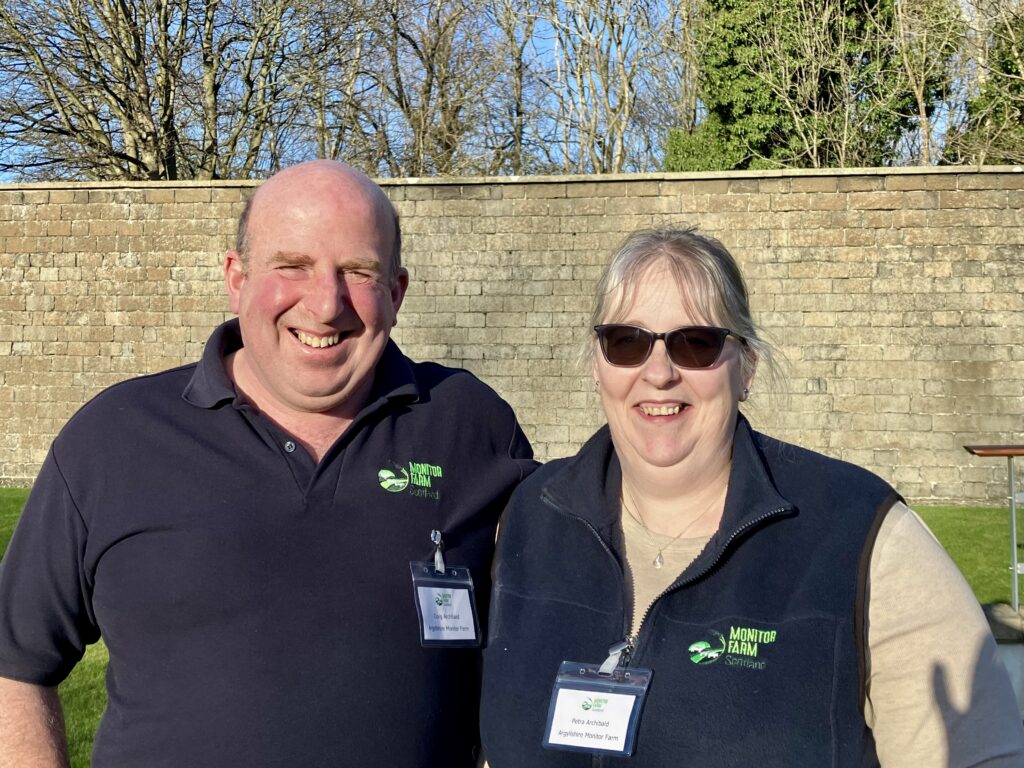
Argyllshire – Craig Archibald, Craigens Farm, Islay; sucklers, store production, ewes and finishing lambs, plus spring barley for local distillery.
Being involved in the virtual fencing project has been a great benefit over summer, but lack of connectivity in autumn meant the 20 trial cows are now housed rather than outwintering. However, with ongoing work to solve technical issues, the second year of virtual fencing will see cows calve outside on extensive sand dunes – something now possible because Craig can create ‘virtual fields’ and find cows who have gone off to calve.
Investigations to find the best suckler cow for the farm will continue. With plenty of data, Craig will also be selecting those who have the traits to do well in virtual fencing to expand the project.
The new Mule flock – a Monitor Farm-driven change – will be assessed for performance, hoping for better productivity, growth and early finishing.
Soil health will also come into focus next year, especially compaction caused by geese, while the benefits of adopting rotational grazing will also become clearer.

Banff and Buchan – Bruce Irvine, Sauchentree, Fraserburgh; suckler cows and breeding ewes, taking progeny through to finishing, arable, plus new hen unit.
Next year is a big one for the Irvine family: “It will be 250 years of our family farming at Sauchentree – my daughters are the tenth generation.”
Monitor Farm-wise, he will be looking at better use of grass, splitting fields to further develop paddock grazing. “We also need to find a better risk management approach for forage crops, as I planted 30 acres of swedes this year and nothing grew.” Being near the coast, the farm is on shallow, sandy soils which are drought-prone.
Deciding on EID systems for cattle is another focus. Bruce is currently involved in trialling electronic boluses in his sucklers, hoping they could highlight events such as calving to help reduce workload.
Changing from organic to conventional two years ago, he wants to improve arable profitability which has dropped since conversion. Another focus is best use of muck from the 32,000 laying hens now on-farm.

Deeside – Duncan and Claire Morrison, Meikle Maldron, Banchory; commercial and pedigree sucklers, offspring sold as store, finished or breeding stock, plus sheep.
Duncan and Claire expanded their farm business this year, obtaining a tenancy on a neighbouring 160-acre farm. Happy with their technical performance and the system they have in place, this year has seen the Monitor Farm and management group concentrate on learning more about business aspects.
This has included sessions on using accounting package Xero on farm, hearing from a banker about what they look for in a business seeking a loan, and financial planning for the future. “They’ve been really interactive sessions with the whole management group, and for next year, I’m asking that group what they would like to do.”
Duncan says one of the things he enjoys most with Monitor Farms is being able to visit other businesses and to discuss what they are doing. “You can hear about what people are doing, but never really grasp it until you see it with your own eyes – it gets you thinking.”
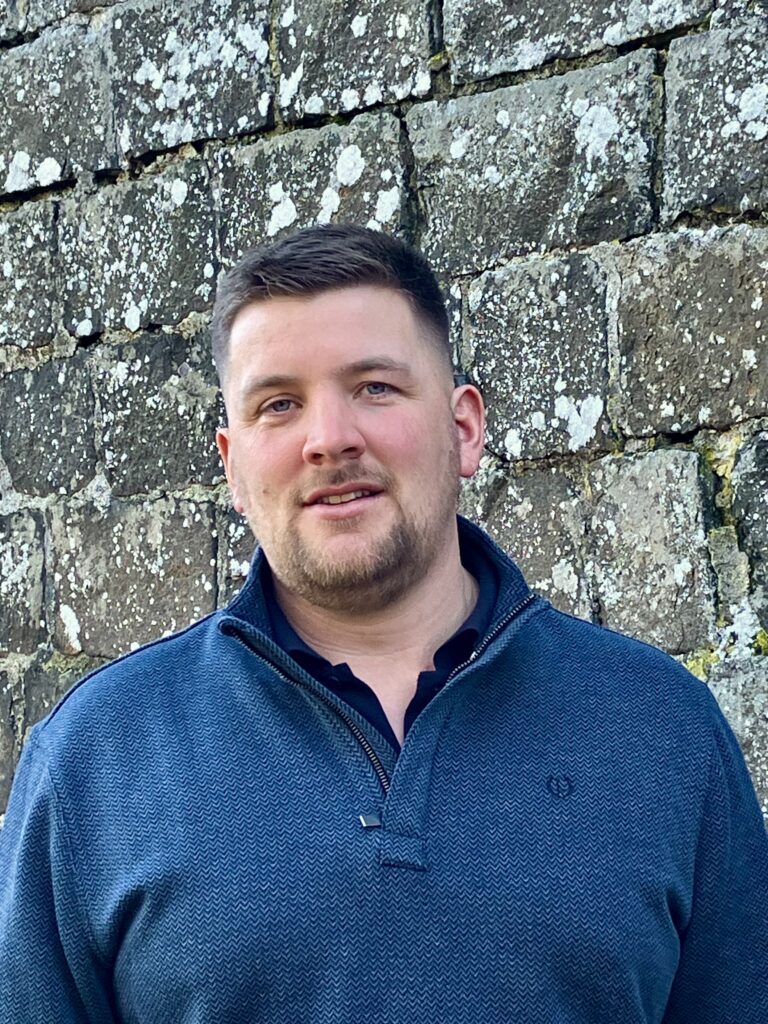
Dumfriesshire – Richard McCornick, Barnbackle, Dumfries; commercial and pedigree sucklers, selling as stores and for breeding, breeding ewes with lambs sold off grass.
Last year’s work using EBVs for selecting a new bull for breeding replacements will see his first crop of calves arrive at Barnbackle, while Richard also plans to start using sexed semen to breed replacements from his best performing commercial cows. As part of this, all his cattle now carry TruTest electronic tags which highlight heats and other health traits.
The sheep have been split into A and B flocks, depending upon performance, and Richard will also start to see the results of not breeding from his ewe lambs but waiting a year longer. “I think we will see them produce more, bigger lambs than if they were bred as ewe lambs. They should also get back in lamb more easily.”
The rotational grazing project at Barnbackle will progress further, and he’s looking at different establishment methods for kale and swede winter forage crops, with discing and using the fertiliser spreader looking successful.
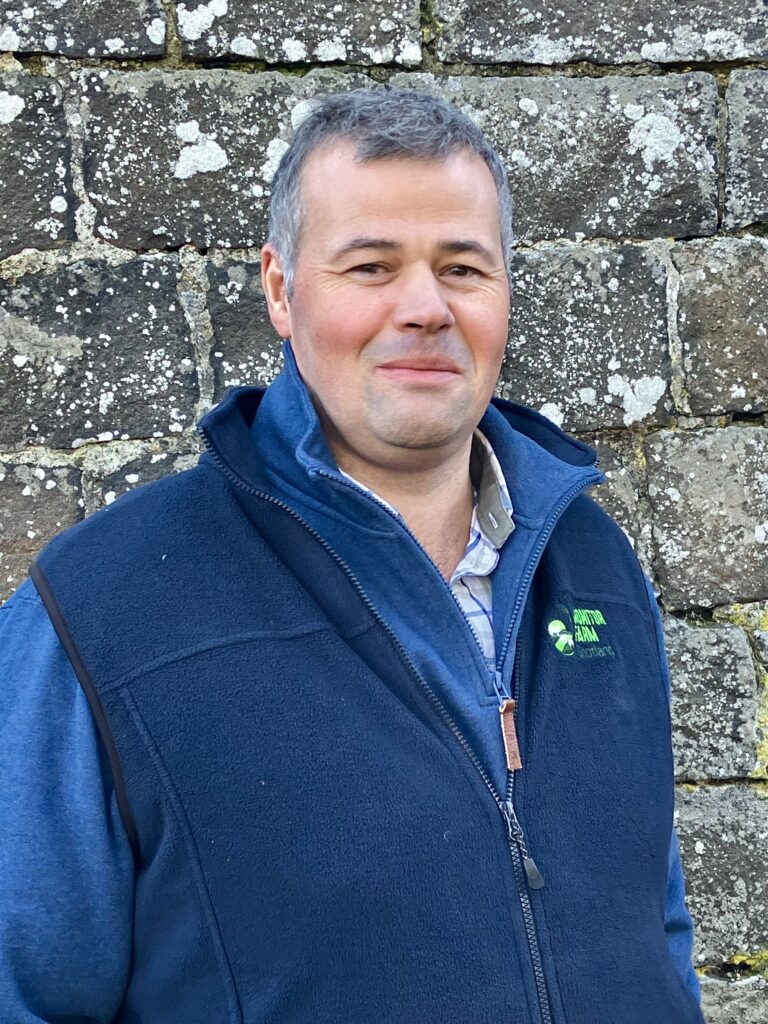
East Lothian – Stuart McNicol, Castleton, North Berwick; arable, with cover crops grazed by sheep over winter plus agri-tourism businesses.
Stuart had a very successful harvest, with all crops yielding well. His spring barley made malting grade, but with poor prices, the area grown will be reduced in 2026. Instead, he will rent the land to a local grower for growing sprouts and cabbage.
He has been trialling cover crops for the last couple of years, but the dry summer and autumn has impacted growth this year. However, the three mixes – one farm saved and the other two being commercially available grazing mixes – are currently being grazed by Hebridean sheep.
With a brome issue, he has been doing more ploughing in addition to chemical control. This is a change to his usual min-till approach, but essential for weed control.
“I’d set out on the Monitor Farm programme to tackle net zero, but we haven’t done that – and neither has anyone else. We’ve also been trying to reduce costs, but that is hard on this size of farm.”

Roxburghshire – Robert Wilson, Cowbog, Kelso; purebred sucklers with offspring sold for breeding or finished, sheep and arable.
There has been lots of change at Cowbog, not least the end of a tenancy which has now become a contract farming agreement, with a proportion of the arable land converting to temporary grass leading to an overall reduction in arable in the business, allowing Robert to run cattle more extensively.
Calving period has been tightened, increasing the spring herd and stopping the autumn calvers. Doing this while trying not to lose production has been ‘slightly like turning round an oil tanker,’ he says.
Cow numbers are growing, and with a feeling that they only needed a maximum of 100 pure Hereford calves, an Aberdeen Angus bull is now being used on 20% of cows; the farm’s first ‘Black Baldie’ calves are due in spring. “That change of sire comes with an opportunity to reevaluate our marketing of stock,” says Robert.
With the increase in cow numbers, he will be looking at what’s best – increasing numbers or maintaining some extensiveness, while escalating winter silage costs will be scrutinised.

South Ayrshire – John and David Andrew, Rowanston, Maybole; sucklers, with progeny and bought-in stores finished, breeding ewes and arable.
A project looking at finishing cattle performance and costs will be a big focus for 2026 for the Andrews. It is following home-bred and bought-in stores who will finish from February onwards. “It will be interesting to see how the different batches and breeds compare,” says David.
They are also going to be trialling finishing bull beef; autumn-born terminal-sired calves will be finished indoors over summer, taking pressure off summer grazing.
They are one of the four farms involved in the virtual fencing project and are keen to see how much more they can achieve with it in 2026. “It would be a thought to go back to not having it now,” he adds.
Having fully set up their rotational grazing system, they plan to make more of it next year, having ‘learned from their mistakes’.
“Overall, we are making tweaks and changes, trying to get the most out of every enterprise,” says David.
Stirlingshire – the Duncan family, Lands of Drumhead and Blairfad; breeding sheep, with stratified system on hill and lowland, plus suckler cows, selling stores.
Grass productivity is a key focus for the Duncans, with a liming and reseeding programme started since becoming a Monitor Farm; they were unaware soil pH levels across the farm were so low. Next year will see more livestock performance results analysed; the family says better grass quality meant they sold more lambs fat this year.
They have also changed sheep breeds, with a new Cheviot flock which they have enjoyed working with and plan to expand.
Their sucklers have been part of the virtual fencing trial, but connectivity issues have meant it has been of limited use this year. With this issue almost solved, they hope to make progress in 2026.
A new cattle handling system – suggested by Monitor Farm visitors – has made weighing much easier, with plenty of data now to assess. They are planning to use the data, alongside much more enterprise-specific costings, to focus on productivity and profitability of each enterprise.

Strathspey – the Smith family, Auchernack, Grantown-on-Spey; commercial suckler cows, selling progeny as stores.
The Smith family are in the middle of a succession transition, with father, Malcolm, now working full-time off the farm and his sons Calum and Hamish full-time on the farm. Next year will see this progress further, with both sons growing their involvement and their contracting business.
The brothers have opted to use a Shorthorn bull on their cows in a change from a Limousin, and have recently bought a second Shorthorn, believing a native breed will suit their system better. Calum says: “We will be pushing forward with the Shorthorns in 2026.”
Being part of the Monitor Farm virtual fencing trial has been a highlight at Auchernack, bringing production and environmental benefits. The family are looking forward to seeing how they can adapt its use and what they can achieve with it in 2026 having had a year’s experience. “This year the grazing set up was a massive boost.”
More on Monitor Farm Scotland
Find out more about each of the Monitor Farms, read meeting reports and see trial results and project updates, as well as finding information about previous Monitor Farm programmes at https://www.monitorfarms.co.uk/. The website also hosts details of upcoming meetings and how to book your space.