
Stirlingshire Monitor Farm
Lands of Drumhead and Blairfad total 505ha (1,250ac) and are situated on the boundary of the Loch Lomond and the Trossachs National Park, near Gartness hamlet in the Endrick valley. They are farmed by the Duncan family, who have a stratified system with the hill farm at Inveruglas producing replacements for the lowland units.
Two of Bruce and Shona’s four children have already returned to the farm from full-time education and are becoming increasingly involved in the running of the farms, with Gregor also returning home after working in New Zealand this winter. Bruce’s parents and father’s cousin also continue to be involved at their respective holdings.
The 30 hill suckler cows and 1,300 Black-faced ewes at Inveruglas have been the basis of the herds and flocks at Lands of Drumhead and Blairfad. In total, the Duncan’s are calving 180-190 cows each year and have a flock of 2,300 sheep.
- About the Farm
Getting involved as a Monitor Farm was a family decision for the Duncans, and, as Shona Duncan explains, it was an opportunity to see if the business was ‘going in the right direction and doing the right things’. “We are always inclined to carry on doing as we have always done unless people question us.”
One of the first information-gathering parts of the project – soil sampling the whole farm – proved to be one of the most shocking, highlighting very low soil pH. Bruce says: “Everyone at the Monitor Farm meeting saw the results and there was a sharp intake of breath. I was embarrassed but was told that probably 90% of the room would have the same result on their farms. We did always lime reseeds, but that was probably one field every five years.”
Now the farm has set an annual budget for liming, as with a total spend of over £30,000 needed to rectify the pH across the farm it was considered too big an outlay to spend in one year. A pad has also been built for arctic wagons to tip 27t loads, making it much easier to handle deliveries. “It’s a bit too early to see the results of applying lime, but we should see more by the end of the programme,” says daughter Rebecca.
The Integrated Land Management Plan carried out highlighted two areas for improvement – profitability in both the sheep and cattle enterprises.
Shona says: “The ILMP showed how poorly the Blackies at Blairfad were performing. After more vet investigation, we discovered we had OPA [ Ovine Pulmonary Adeno-carcinoma] in the flock. We had an open Monitor Farm meeting about the issue, which I think opened a lot of eyes and helped us all understand the disease much more.” The depth of this ‘iceberg’ disease and its impact on productivity means the Blairfad Blackie flock has now been culled and replaced with Cheviots.
The family has also tackled lameness in their flocks, and while they had vaccinated hoggs against footrot in the past, they now vaccinate ewes too. A stringent culling policy is underway, with lame ewes being tagged and treated, then culled if they are found to be lame again. The farm has also concreted its sheep fank to help with better biosecurity and to make working easier; Shona admits this was always a plan, but finding the time to dismantle the busy fank to lay concrete was a barrier to doing it in the past.
Rebecca adds: “It has sometimes been too easy to find excuses, but the Monitor Farm holds us accountable. If we discuss a topic with a group of farmers, they want to see results so there is an obligation to sort it out.” And while Bruce adds that it’s not always successful, it’s interesting for everyone to see what happens.
Rebecca has also been looking at cattle performance and profitability data. “I like working with numbers, and there is a lot of information on the cattle side that we can work with straightaway.” As a result, the family is now employing a stricter culling and replacement policy in their herd. It has reduced in age significantly, with heifers now calving at two years old rather than three, speeding genetic progress. “We have also been taking out under-performing cows, and we will be calving 20 fewer cows this year as a result.”
Some progeny are being sold earlier as a result of analysing profit/head, as Bruce explains. “I always thought our cattle did well and the system was working, but when we came to look at the costs as part of the Monitor Farm, I realised we weren’t doing so well after all!” After analysing calf wintering costs, more calves were sold in the autumn last year rather than being sold in the spring out of sheds. This means the remaining calves can all be taken to the end of the next grazing season to maximise profit.
After unanimous comment from the Monitor Farm’s management group, the cattle handling facilities are being upgraded. “Moving hurdles, the crush and so on between two farms was a bit of a performance,” he says. Rebecca adds that this will be much more efficient: Running cattle through the crush can now be done by one person in a day, rather than the previous system taking two to three people two to three days.
With the Monitor Farm’s changes – soil pH and breeding – being long-term projects, the family believes the four-year programme will be more able to show the difference than the previous three-year timescale. They’ve also enjoyed the social aspect of the programme, and visiting some of the other Monitor Farms. “It’s good to find out that others have the same problems as us,” adds Shona.

- Rebecca Duncan
“It has sometimes been too easy to find excuses, but the Monitor Farm holds us accountable. If we discuss a topic with a group of farmers, they want to see results so there is an obligation to sort it out.”

- Final Year of Programme Plans
Grass productivity is a key focus for the Duncans, with a liming and reseeding programme started since becoming a Monitor Farm; they were unaware soil pH levels across the farm were so low. Next year will see more livestock performance results analysed; the family says better grass quality meant they sold more lambs fat this year.
They have also changed sheep breeds, with a new Cheviot flock which they have enjoyed working with and plan to expand.
Their sucklers have been part of the virtual fencing trial, but connectivity issues have meant it has been of limited use this year. With this issue almost solved, they hope to make progress in 2026.
A new cattle handling system – suggested by Monitor Farm visitors – has made weighing much easier, with plenty of data now to assess. They are planning to use the data, alongside much more enterprise-specific costings, to focus on productivity and profitability of each enterprise.
Meeting Reports
-
-

-
 February 2025 Meeting Report
Topics Prioritising pasture with Graham Lofthouse Planning for profit with Emily Grant Mini Workshop - Body Condition Scoring ewes pre-lambing
download -
 October 2024 Meeting Report
Topics Iceberg Diseases - OPA in Sheep OPA Scanning Demo Testing bloods for Trace Elements
download -
 June 2024 Meeting Report
Topics The Sustainable Suckler Cow Sustainable Parasite Control can save time and money Can AECS work for your farm and the value of your farm's environment
download -
 October 2023 Meeting Report
Topics Scanning and Managing OPA (Jaagsiekte) in Your Flock and the Benefits of Blood Testing Pre-Tupping for Minerals and Other Iceberg Diseases
download -
 June 2023 Meeting Report
Topics Grazing - Graham Lofthouse. Drainage - Jamie Dick. Soils - Catriona Mclean SoilEssentials.
download -

Presentation
-
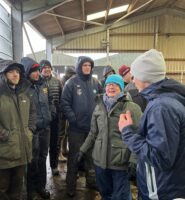 Forage Crops and Calf Growth Targets
Farm advisers Emily Grant and Graham Lofthouse presented at the Stirlingshire Winter Open Meeting in February 2026.
download
- Argyllshire Monitor Farm - Demonstration and Discussion on the Use of Agricultural Drones
- Argyllshire Monitor Farm - Winter Fodder Crop Varieties with Craig Archibald
- Healthy Lambing at the Banff and Buchan Monitor Farm