Virtual fencing project’s summer of progress on Monitor Farms
- Virtual fencing being assessed for cost-benefit over two years on four Monitor Farms.
- More efficient, effective use of hill grazing achieved, also reducing overgrazing.
- Management benefits becoming apparent, but some challenges remain.
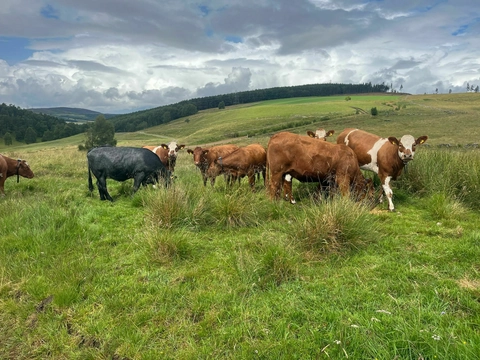
Four of Scotland’s Monitor Farms are trialling an innovative virtual fencing system on their hill and upland grazing and are already seeing environmental and cattle management benefits, but some challenges have been identified.
The four Monitor Farms involved – Argyllshire, South Ayrshire, Stirlingshire and Strathspey – have 25 collars apiece from Norwegian specialist Monil and are testing them in their herds to assess the cost-benefit in a two-year project.
The farms have all run cattle at grass this summer and have managed their grazing areas using the collars and the associated app. Initially, they started the project by fitting the solar-powered collars, training their cattle to turn away when they hear the collar’s signal for the virtual fence, and then turned their cows out on upland and hill grazing. The virtual fence is set using the app, where the fence, individual animal location and movement, plus any escapees, are seen. The virtual fences can be moved and any breakouts managed remotely via the app, with notifications sent when cattle don’t move for a certain period.
On the South Ayrshire Monitor Farm, David Andrew has been busy calving his collar-wearing heifers, who have now moved off the main hill grazing to in-bye land.
“Having the collars means we can find them very easily when it could have taken us hours in the past if we were looking for a missing cow in bracken or on a foggy day with little visibility on the hill, especially if an animal had gone away from the main herd to calve, which often happens. Now it takes us 15 minutes to find and check the cattle, but took us up to an hour before, and I now wonder how we did it before this technology!”
Their in-bye land also has an area which has been reseeded with a kale and stubble turnip mix, and the virtual fencing has been used to successfully exclude cows from this area, he says. When they were on the hill, the virtual fencing meant they grazed areas they would not normally visit. “When it came to gathering the sheep, I don’t think I’ve ever gathered more ewes off that side of the hill – you can see the good the cattle grazing has done.”
At the Strathspey Monitor Farm, brothers Calum and Hamish Smith are also positive, though they have had a few breakouts in recent weeks, something they put down to some disturbance from other groups of cattle. “We also had two heifers whose collars came off, and it was two or three weeks before we could put them back on. We can see those animals were excessively testing the virtual fencing boundaries after that.” The heifers have grown since the collars were first put on, so a few have also needed adjusting.
The Smiths have used virtual fencing to manage their hill land much more effectively and are now able to graze areas with poor physical fencing. They have been rotating heifers round three large ‘virtual paddocks’ and have found moving them in the evenings when they are settled has worked well. “The cattle and the hill look well,” says Calum. They hope to keep the heifers out for longer this autumn as a consequence and may then put the collars onto cows who overwinter outside.
For the Stirlingshire Monitor Farm, the trial has been more challenging, with connectivity issues meaning they have not been able to make full use of the technology at their Inveruglas hill unit. Rebecca Duncan says: “We have ended up using the collars more like trackers, but the signal is very patchy. We have had one animal who got ‘stuck’ inside the virtual fence and another group of four who split from the rest too.” Work to address the connectivity issue is continuing with the collar and technology supplier Monil.
Connectivity has also been an issue at times on the Argyll Monitor Farm on Islay, says farmer Craig Archibald. “Closer to home it has worked better, but certain pastures have been difficult, especially where the cattle have gone into the shadows of the hills. It also means it takes quite a time to update.”
However, he says that the system has mostly worked well, and animals have grazed down a lot of the farm’s rougher, longer grass, especially Molinia. He is also grazing sheep alongside the cattle, and being able to keep the gates open has made gathering sheep much easier.
Grass on the farm was analysed this summer, with a little supplementary feeding given in this first year to compensate for the lower nutritional value of the hill grass. However, grass quality is already improving with grazing this year and will be analysed again next summer; it’s thought that in future little to no supplementary feeding will be required.
The cattle have recently been body condition scored, and have maintained their condition, so will be outwintered, calving outside next spring. They are usually housed in winter, but better use of grass means there’s an option for outwintering, freeing up indoor space and allowing Craig to bring in other cattle for winter feeding. Outwintering cattle will also test the collars’ solar power capability, which has not yet been an issue on-farm.
Providing an update on progress, Monitor Farm regional adviser Christine Cuthbertson says: “It has been really interesting to see how the different farms have found using the collars. The connectivity issues have been a challenge, especially for the Stirlingshire Monitor Farm, but we hope this will be resolved shortly. I am looking forward to seeing how results look this autumn and how the farms might be able to change their approach using virtual fencing.”
Further information:
The Monitor Farms and their virtual fencing goals:
Argyll – the Archibald family are trialling with 25 of the farm’s 225 Aberdeen Angus cows on hill land at Craigens Farm. Their goals are:
- Use hill ground which isn’t currently grazed by cattle in summer and potentially the shoulders of winter to make more grazing available.
- Use unused poor hill grazing that sheep don’t use to increase herd size and calf sales.
- Grazing hill will improve grass for sheep.
- Improve biodiversity of the hill which may lead into future farm support/management schemes.
- Keep herd in safe areas, i.e. away from bogs and ditches as well as any protected areas.
South Ayrshire – John and David Andrew are trialling on 25 of the farm’s 150 breeding cattle at their Blair hill farm. Their goals are:
- Use underused area of hill ground in summer and potentially the shoulders of winter to make more grazing available.
- Ease of management when calving outside. Keep cows to one area.
- Keep bull tight when running with cows.
- Easier to locate cows or quickly see if there is an issue.
- Potential to graze neighbouring woodland – extra grazing is always needed.
Stirlingshire – the Duncan family, trialling with 25 native-bred hill cows at Lands of Drumhead and Inveruglas. Their key goals:
- Locate cows and calves more easily.
- Use to monitor cow movements to check all is well.
- Keep herd in safe areas. i.e. away from walking routes, deep cervices.
- Use current under-grazed areas to improve grass quality for sheep grazing.
- Run bull in a defined area with cows to catch more and reduce bulling time.
- Free up more time/labour to focus on production at Lands of Drumhead.
- Improve personal safety (not having to search for cows).
Strathspey – the Smiths at Auchernack are trialling the technology with 13 Shorthorn x Limousin bulling heifers on a hill which requires targeted grazing for biodiversity and also on 11 heifers in-bye, potentially on species-rich grassland (an important, but undergrazed Strathspey habitat). They may put one collar on the bull with the heifers. Their goals are:
- Locate heifers on the hill more easily.
- Heifers will run with the bull in a defined area, so he will potentially catch more and tighten the calving period.
- Targeted grazing across the hill on different habitats.
- Use to monitor cattle movements to check all is well.
- Free up more grazing ground in-bye
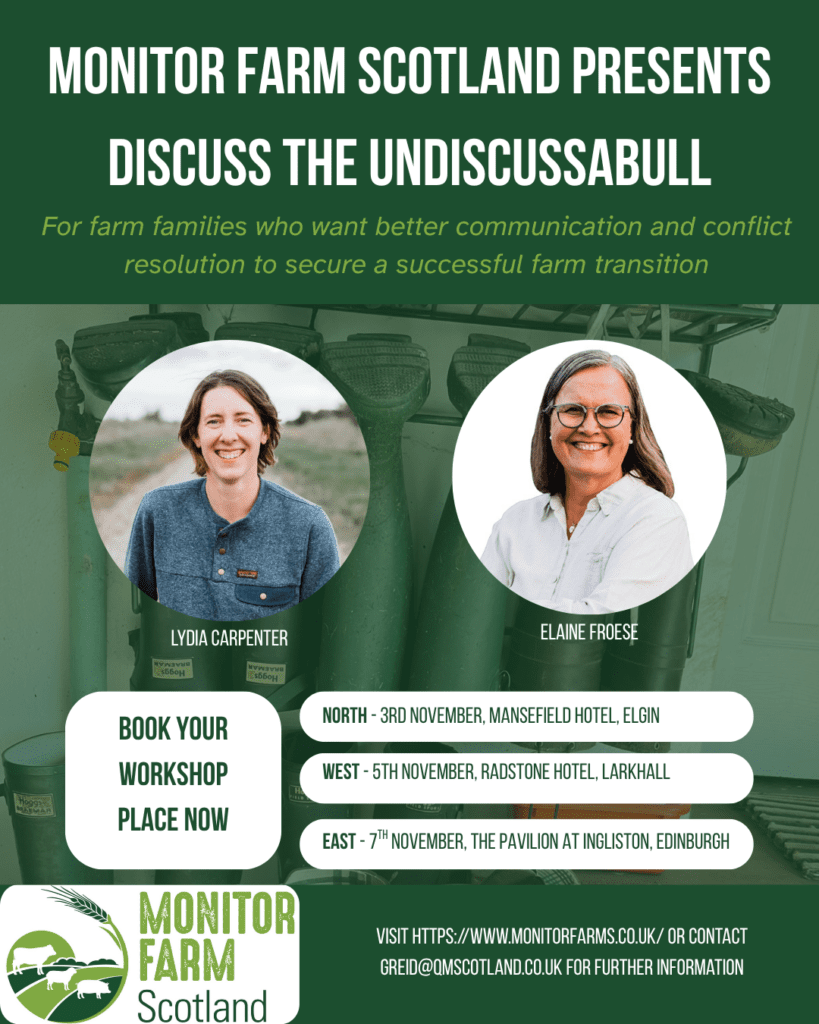
Monitor Farm Scotland is launching a new series of workshops this November to help farming families across Scotland tackle one of the biggest challenges in agriculture—communicating effectively about the future. The events will focus on farm family relationships, conflict resolution, and succession planning, providing practical tools to support smoother transitions and stronger businesses.
Taking place in Elgin, Larkhall, and Ingliston, the workshops will bring together farming families from across the North, West, and East of Scotland, making it easier for people to access support and advice close to home.
Building on the success of AHDB’s 2024 events, these sessions will feature Canadian expert Lydia Carpenter of Farm Family Coach Inc., who will provide practical tools and specialist insights to help families strengthen relationships and plan for the future.
The workshops, themed “For Farm Families Who Want Better Communication & Conflict Resolution to Secure a Successful Farm Transition,” will explore succession planning, management transitions, and intergenerational communication—issues at the heart of many farming families. Through real-life stories and professional guidance from Lydia Carpenter, who works closely with renowned expert Elaine Froese, attendees will gain a deeper understanding of the emotional, financial, and practical aspects of handing over the reins.
Registration is required, please click on links below:
Farming families across Scotland are invited to attend the workshops at the following locations:
Elaine Froese, joining remotely, will offer bespoke insights on “Finding Fairness in Farm Transition,” recognising that perceptions of fairness vary depending on which family or farm team member is involved. She explains:
“The emotional factors affecting planning can be managed to help folks get clarity of expectations, certainty of timelines and agreements, and a commitment to act. Once you start talking openly, great solutions can be created. Families who stop the conflict avoidance dance are relieved to find out that expressing emotion and creating solutions can be done in a safe and respectful manner.
You get the behaviour you accept on your farms, so start looking for new ways to reach out and adapt to each other’s needs. When needs are met, conflict decreases.”
Lydia Carpenter comments:
“The mindset shift that needs to happen in agriculture is that communication and conflict is not bad. You can have good conflict, which in farm transition is what can ignite the creativity that is needed to get things done. Running a farm, and working through a farm transition, is complex, but that does not mean it has to be complicated. We are passionate about sharing tools and insights that can help farm families and teams be in spaces that feel constructive and generative. Sometimes that means addressing tension, conflict, and communication challenges to make the next steps in farm and ranch transition. We are passionate about the work we do. Learning better communication and conflict resolution skills is within farmers’ control and can be embraced as a risk management strategy for their operation, helping with family dynamics and future planning.”
Grace Reid, Monitor Farm Scotland Programme Manager (Maternity Cover), adds:
“Navigating difficult conversations with family or business partners is something every farmer can relate to. These workshops will build confidence, strengthen communication skills, and help farmers tackle sensitive topics head-on, supporting a successful future for their business. We have also produced a bespoke podcast series to complement the workshops. You can listen to the episodes via the Monitor Farm Podcast Field Talk, where we explore the conversations that matter most.”
All workshops are free to attend, with lunch, tea, and coffee provided. As an added bonus, each attendee will receive a workbook to guide them through the exercises, along with the opportunity to complete a Conflict Dynamics Profile (CDP). This tool helps individuals understand how they respond to conflict by highlighting constructive behaviours (like perspective-taking and solution-creating), destructive habits (such as avoiding or retaliating), and personal “hot buttons” that trigger strong reactions. It offers valuable insights to improve communication and aims to help reduce drama in farm family dynamics.
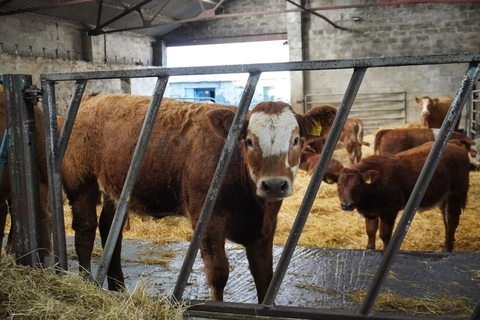
Farmers are being reminded to talk to their vet and to vaccinate young cattle and calves for pneumonia this autumn after a Strathspey Monitor Farm study showed an outbreak led to a multi-thousand-pound loss for the business.
Treating an outbreak is often regarded as a big expense in terms of vet and med costs – but it was the consequent poor performance which contributed most to losses.
Enduring the ‘horrible’ outbreak of pneumonia at Auchernack near Grantown on Spey was tough for Monitor Farmer Malcolm Smith. He and his family aim to produce top-quality, growthy store cattle from their 150 sucklers, calving from mid-November to early January and from late March to May. Back-end calves are weaned and housed in October, with spring-born calves weaned and housed in November. Cattle are sold at 12-14 months.
The run-up to housing generally always sees young cattle and calves vaccinated for pneumonia. In January 2023 the farm had a few clinical cases in calves and young cattle, and these were treated on-farm. In the October, a few more clinical cases were treated, and 40 of the back-end calves were vaccinated with Bovilis Intranasal RSP.
However, a sudden turn in the weather and the need to get cattle in quickly, coupled with pressure of other work, meant spring-born calves weren’t vaccinated before coming inside in November. All seemed fine initially, but by December these calves had pneumonia, says Jane Harley, clinical director of the farm’s veterinary practice, Strathspey Vets. “They were treated and we took samples, which confirmed this was RSV.”
She explains that most vets offer subsidised testing via the vet pharmaceutical companies. “The tests will confirm you are treating for the right thing.”
The vet and med costs for tackling the outbreak came to £800, with lab fees and investigations costing a further £300. However, Malcolm says this was only a small part of the cost of the outbreak; the financial implication of lost performance in the cattle was dramatic.
The farm was feeding for 1kg/head daily liveweight gain (dlwg), but from the start of the outbreak until the end of January, average dlwg fell to 0.6kg/head/day. “Over the two months of the outbreak, cattle averaged only 36kg/head growth, where we had been expecting 60kg/head.”
After the outbreak, although most cattle recovered and growth efficiency returned, some continued to under-perform due to permanent lung damage, he says.
With the diet to achieve 1kg/head dlwg costed at £1.35/head/day, or £116/day for the group of 86 calves, the drop in performance saw the equivalent diet cost almost doubling to £2.25/head/day, or £193.50/day for the group.
“Although weight gain increased back to normal for most of the cattle, if you don’t recover the kilograms lost during the outbreak then the costs mount up,” he says.
With the farm’s usual store sale weight reduced by 24kg/head at an average sale price of £3.29/kg, the cost of reduced performance was almost £79/head, with a group cost of £6,790.
Jane says: “To that we should add the cost of Malcolm’s time running calves through the handling system three times to examine them, take samples, treat them, check temperatures and record weights and treatments and so on. There’s also the stress involved and the mental health impact too.”
With the overall market loss standing at £6,790, then the additional costs such as the vet, etc coming to £1,600, the total cost of £8,390 was a big financial penalty for the farm, says Malcolm.
“We’ve been open about the costs and losses as it is scary. If you’re feeding for dlwg of 1kg and getting 0.1kg, which we were in some cases, it soon adds up. Vaccinating would have cost us £700 and we have made it a priority now.” This autumn, the Smiths plan to vaccinate at least a couple of weeks before housing, reducing the stress of doing everything at once.
Jane adds: “The farm is nearly £8,500 worse off as a result of this outbreak – and there is the time involved to factor in too.
“Talk to your vet at any time regarding vaccines as each farm will be different depending on what is causing the pneumonia but also what the management system is in relation to calving periods, housing and so on. Be aware of lungworm before housing and also check in with your own vets re Blue Tongue vaccines and movements.
“Many farm have the odd case of pneumonia here and there, and it’s easy to forget that these do mount up, so talk to your vet even if it’s just a few animals. Ask for a test to see what you are contending with and make sure you are treating for the right thing. There are some farmers who do test, but not as many as we would like.
“My main message is to talk to your vet, and the key thing from this case study is that making time to vaccinate – and for the right thing on your farm – is crucial,” she says.
- A Monitor Farm podcast about the outbreak and also covering nutrition on the Strathspey farm is available here: https://youtu.be/ITpADRxJBYQ?feature=shared

Monitor Farm Scotland is delighted to welcome Iona Smith, who joined the team on 22 August as a Regional Advisor.
Iona brings a wealth of experience to the role. Most recently, she worked with Blackhall & Powis as a Graduate Land Manager where she was involved in numerous onshore and offshore renewable projects all over the country. She was brought up on a pedigree beef and sheep farm in Turnberry, South Ayrshire and went on to complete an Honours Degree in Rural Business Management at SRUC Edinburgh. Alongside her professional work, Iona is also the current Chair of Women in Agriculture Scotland, and this October is leading the UK team to the World Hereford Conference in Kansas City, America which demonstrates her commitment and passion for the farming sector.
In her new role, Iona will be supporting the Dumfriesshire, East Lothian and Roxburghshire Monitor Farms, taking on the cluster previously covered by Maura Wilson, who is moving on after three years in the role.
Iona Smith, added: “I am pleased to join the Monitor Farm Scotland programme; it’s a real honour to be part of such a prestigious team supporting producers. With a strong commitment to the agricultural community and my full life being centred around this amazing industry, I look forward to contributing to the success of the Monitor Farm Scotland initiative. Together, we can drive progress and ensure the continued excellence of our farming practices.”
Grace Reid, Monitor Farm Programme Manager (Maternity Cover), added: “We are really pleased to welcome Iona into the team as we head into the final year of the current four year programme. I’d like to thank Maura for her fantastic contributions so far and the support she has given to the farms in her cluster. We wish her all the best for the future.”
Reflecting on her time with Monitor Farm Scotland, Maura said: “Seeing everyone grow in confidence and become more open has been a highlight of this role. They’re more willing to challenge issues, adopt innovation and have meaningful conversations. I’m hopeful the farmers involved now will continue to embrace change and improvements.”
For the latest updates, follow @MonitorFarmScotland on social media or visit www.monitorfarmscotland.co.uk.
With recent positivity in the beef market and an industry call to keep more cows to maintain Scottish red meat production, suckler producers at the recent Deeside Monitor Farm open meeting discussed options to increase herd size and productivity.
Deeside Monitor Farmers Duncan and Claire Morrison from Meikle Maldron at Torphins near Banchory have recently been successful in obtaining a secure tenancy on a neighbouring unit. The additional 164 acres takes their total area farmed to 770 acres, mainly grassland, across four farms, with 110 acres owned, 430 acres tenanted and the rest seasonal lets. About 260 cows and heifers will be bulled this summer, consisting of pure Aberdeen Angus and Stabilisers plus a commercial herd; now they want to increase cow numbers to 320.
Speaking at the meeting, SAC Consulting senior beef specialist Gavin Hill said that while cow numbers in Scotland had dropped by 11.7% from 2015 to 2024 (a loss of 51,000 cows), some farms have increased cow numbers. Recent cattle prices have been encouraging but confidence is still needed. Economic pressure still dictates decisions, he said.
Now, 56% of Scotland’s suckler cows are kept on only 16% of holdings, with some suckler herds working with 600-900 breeding cows. “With larger breeding numbers, the aim is to spread their overheads over more cows to lower costs per head,” he said.
“In times of challenge there is innovation and adoption of ways to reducing costs. Some farms have worked to better use the scale and scope of the land they farm, such as outwintering on hill and upland areas, using collars to access areas they previously couldn’t graze and outwintering on hard hill areas with additional forage.”
He added that technical improvement will always be an aim, particularly suckler fertility, where numbers reared for every 100 cows put to the bull is still only about 86%. “That is a loss of a potential 14 calves in every 100 cows. However, although we may not have improved calving percentage, it has to be noted that bulling periods are far shorter than some years back.
“Another area to focus on is the use of data – if we are to maximise returns then more monitoring of performance is still needed. It is still concerning how many store cattle are going through the market at a very low weight for their age.”
Leading a discussion about how the Morrisons could increase cow numbers by 60, he said it was important to consider where those replacements should come from.
The future should be in youthful cows, so the focus should be on heifer replacements, he said. However, they need to fit into the Morrisons’ ethos. They breed for maternal traits and have a short bulling period of six to seven weeks, so current selected replacements are similar ages, come from the most fertile females in the herd, must achieve more than 1kg DLWG and have a good pelvic score. Gavin warned that buying replacements from out with the herd comes at a large capital and potential health cost.
However, cattle vet Tim Geraghty explained that increasing herd size quickly using only home-bred heifers could be challenging on top of maintaining replacement rates for older cows. “Herd expansion puts pressure on selection – a farmer may need to hold back heifers for replacements that are sub optimal, and the choice between retaining the best heifers versus selling these for the most money is a cash flow pressure known to all farmers!”
He discussed the pros and cons of two other potential options for the Morrisons; buying in heifers to allow rapid expansion, but with cash implications and health risks, or using AI and sexed semen to increase homebred females available for selection. Using sexed semen is a realistic option now Duncan has completed an AI course, and so both synchronized fixed time programmes, or using AI to naturally observed heats, could be used.
Also speaking at the meeting, breeder Neil McGowan from Incheoch Farm in Glenisla described ‘The Ultimate Cow’. She had to be fertile and able to calve at two years old and again at three, which could often be a challenge as the heifer is still growing while rearing a first calf.
“She needs to be producing calves regularly, ideally at around 365 days, to calve without assistance and to be fun to be around, so a good temperament, with good feet, good teats and udder.
“Recording these cow performance indicators and selecting from them is critical. In addition, the ultimate cow needs to fit into the environment of the farm, be low management – so in the case of the Morrisons, a cow that calves easily, keeps condition through winter and thrives in a low input system – and deliver what the market demands.”
Monitor Farm regional adviser Peter Beattie added: “I was delighted to hear so much positivity about growing suckler herds from the Morrisons, the speakers and attendees at the meeting. It was a practical, productive meeting, full of optimism and discussion.”
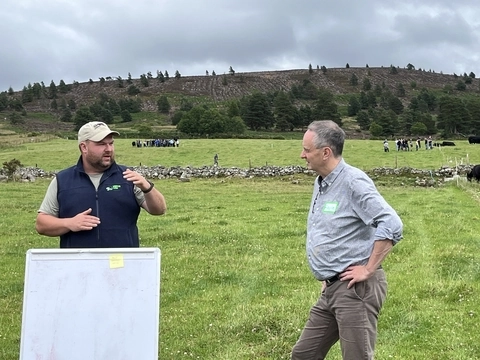
Farm technology has the potential to improve productivity, profitability and sustainability of this and other Highland farms. Three technologies were on display at the July Open meet, covering grassland management, dock control and virtual fencing.
Critical Mass, Breeding Replacements, Herd Health and ‘The Ultimate Cow’ were up for discussion at July’s Deeside Monitor Farm Open Meet in July 2025.
Duncan and Claire Morrison were joined at Meikle Maldron by consultant Gavin Hill, SAC, vet Tim Geraghty and farmer Neil MacGowan, Incheoch Farm. This report summarises the key points in growing a successful suckler herd.
John Ritchie, Montalt Farm, and Iain Chapman, Farmlay MD discuss time and efficiency at the Banff & Buchan Monitor Farm Summer Open Meeting in June 2025.
Making a success of re-seeds, lamb weaning and virtual fencing
On Friday 11 July 2025, 32 members of the Stirlingshire farming community came along to Lands of Drumhead Farm, Balfron Station, for the Monitor Farm Summer Open meeting.
Monitor Farmers, the Duncan’s, gave an update as to what had been happening on the farm including using virtual fencing for the 25 cows at Inveruglas.
The Duncan family want to produce more kilos from grass. The attendees discussed the re-seed with the Duncan family, Graham Lofthouse (Farm Advisor), and Pat Lambert (Watsons Seeds).
The Management Group wanted to focus on how to wean lambs successfully. Emily Grant has been advising the Duncan family on how to increase farm profits.
Don’t Fence Me In!
On Friday 9 July 2025, 37 members of the South Ayrshire farming community came along to Knockroon Farm, Crosshill, for the Monitor Farm Summer Open meeting.
Monitor Farmers John and David Andrew gave an update on what has been happening on farm, including very positive feedback on being part of the Virtual Fencing project with 25 heifers grazing on an under-utilised area of Blair hill.
Attendees had the opportunity to hear from the Moredun Research Institute and explore the Mobile Laboratory. Dr Eilidh Geddes and Dr Sarah Thomson, used the lab to demonstrate how to do a faecal egg count with farmers bringing their own samples along for testing.
John Ritchie of Montault Farm discussed the process and infrastructure to set up a rotational grazing on you farm, demonstrated by showing the system that had been set up at Knockroon Farm with his practical support.