Pneumonia in winter livestock is painful, both emotionally and financially.
The Strathspey Monitor Farm Vet Special Event in November 2024 featured Monitor Farmer Malcolm Smith, SRUC’s Franz Brulisauer, MSD’s Sara Robson and Strathspey Vet’s Jane Harley.
This Monitor Farm Special Report:
- Explains the various causes of pneumonia
- Discusses vet testing and
- Encourages preventative management
Read the Meeting Report here.
The performance commences at 6pm at United Auctions, Stirling on Wednesday 12 February 2025.
Succeed at Succession. A classic, smash hit, rural play of the 2000s on Succession Planning is brought bang up to date by Monitor Farm Scotland. The sticky, family issues of legal rights, tax law and accountancy are on display through classic acting performances around the kitchen table from Johnston Carmichael, Virgin Money, and Shepherd & Wedderburn.


Argyllshire Winter Meeting Report – 5 November 2024
35 members of the farming community attended the meeting, and we welcome a few new faces too which was great to see! This meeting was requested by the farming community on Islay and covered:
- What to expect from a Scottish Government RPID Inspection.
- Quality Meat Scotland Farm Assessment.
- How to do your own farm carbon audit.
- How to update your farm carbon audit.
Cattle and Sheep Nutrition Workshop – Stirlingshire Monitor Farm
The Stirling Monitor Farm Management Group members had the chance to attend a Cattle and Sheep Nutrition Workshop in August. Led by Ruminant Nutritionist Lorna Shaw of SAC Consulting, the group had full day of learning about:
- Forage analysis and quality.
- Estimating Dry Matter and intake.
- Stock requirements.
- Minerals.
Watch the video to find out why farmers get involved and how they benefit from the Monitor Farm programme.
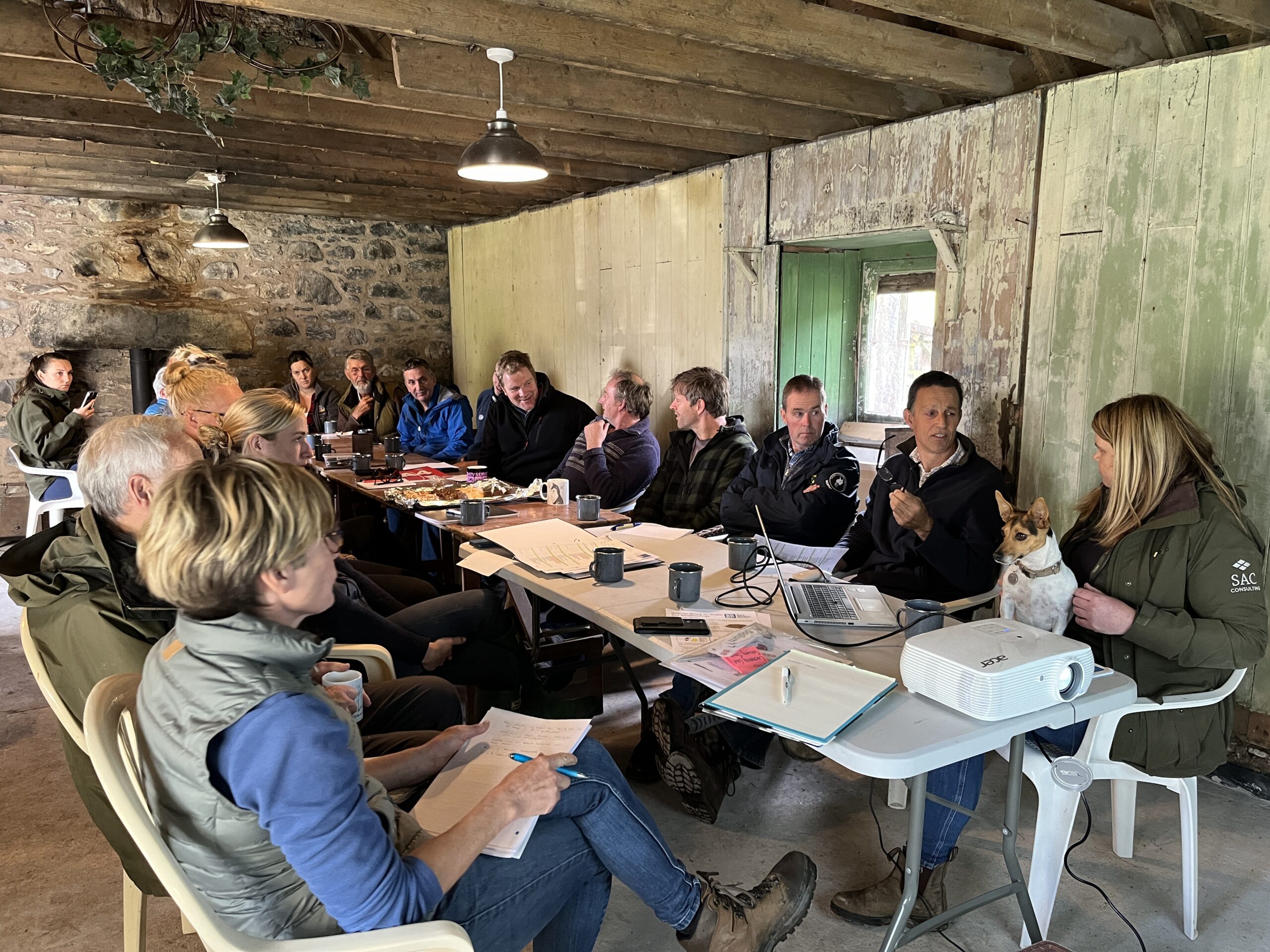
A ‘Sheep Special’ meeting was held with the group on 27 August 2024. Our guest speakers were SAC Ruminant Nutritionist, Lorna Shaw and Vet, Beth Newman. Lorna had spent the day previous helping at lamb weaning and discussing a practical sheep strategy for the Argyllshire Monitor farm.
Islay vet Beth discussed the value of Tup MOT’s and demonstrated how these should be carried out and what to look for.

Our guest speakers Robert Gilchrist (Aberdeen Angus Cattle Society), Alex Pirie (SAC) and Lynsey Melville (Mordeun) share their key take home messages from the Stirlingshire Summer 2024 meeting ‘Increasing the Sustainability of Your Livestock Farm’.
With help from a variety of speakers and with SAC forecasts for his enterprise, Duncan Morrison, the Deeside Monitor Farmer answered his question, ‘Is finishing bulls at grass better or worse financially than finishing intensively?’
Finishing beef bulls at grass cuts costs
Duncan and Claire Morrison finish their mainly Stabiliser beef bulls at grass. The Summer 24 Open meeting shows how good grass management, supplementary feed and hitting the target at the abattoir are critical to profit.
-high feed prices can make indoor finishing expensive.
-Ingliston’s breeding bulls do well off grass and are at a good weight by 16 months.
-outdoor finishing has cut variable costs from £712/head to an estimated £377/head.
-estimated margins are £466 compared with £214/head, an additional return of £252/head
-key is rotational paddock grazing, moving every 2-3 days
-Duncan uses Farmax grazing software to plan rotations.
-swards must be high quality with good ME (12.7 MJ/kg at Ingliston in May
-sward protein is boosted by red and white clover (27% in May)
Duncan commented “I am really pleased with how this has gone, and the weight gain so far has been very good, so I am cautiously optimistic. But I would caveat this by adding that we are not finished yet and will need to see how they grade.”
| Timing | Feed | Av Weight |
| 200-day avg | Adlib silage & wholecrop | 273kg |
| Turnout 17th April | Grass fed + 1kg blend | 375kg |
| 12th June | Grass + 2kg blend | 484kg |
| 8th July | Grass +4kg blend | 540kg |
| Groups at turnout | Egg countper gramme | DLWG-pre worming | DLWG – post worming* |
| Light Group Below 350kg | 570 | 1.75kg | 2.21kg |
| Heavy GroupAbove 350kg | 330 | 2.02kg | 2.25kg |
Detailed costings (by Kirsten Williams, SAC)
| OUTPUT | 2023 | 2024 |
| Sale Value | | |
| 347kg @ 483p/kg | £1,676.01 | |
| 337kg @ 475p/kg | | £1,602.51 |
| | | |
| Less value @ weaning | | |
| 300kg @ 250p/kg | £750.00 | £750.00 |
| | | |
| TOTAL OUTPUT | £926.01 | £852.51 |
| | | |
| VARIABLE COSTS | | |
| Concentrates | £546.17 | £149.50 |
| Whole Crop@ £45/t | £113.00 | £0.00 |
| Whole Crop/Silage @ £40/t | £0.00 | £120.00 |
| Grass @ 6p/kg DM (70t) | £0.00 | £87.12 |
| Bedding Straw @ £12/bale | £51.25 | £28.75 |
| Vet & Medicines | £1.25 | £1.25 |
| Commission, haulage, levies | | |
| TOTAL VARIABLE COSTS | £711.67 | £386.62 |
| | | |
| GROSS MARGIN £/head | £214.34 | £465.89 |
While it can be a difficult and lengthy process, tackling lameness will have a positive impact on flock performance, and weaning is the ideal time to make a start. That is according to Marion McMillan, a vet with SRUC. She is also a member of the Management Group of the South Ayrshire Monitor Farm, and will be playing a key part in discussions and practical work in the flock at Rowanston.
Net Zero ‘marathon’ needs best science and accurate data
Farmers at June’s Banff and Buchan Monitor Farm meeting heard that net zero was ‘a marathon and not a sprint’, and that farming needed to insist on the best science, with accurate, precise data on individual farms in order to choose the right options and to defend itself.
Key speaker Professor John Gilliland, who owns a farm as well as being a special adviser to QMS and AHDB on net zero, discussed his experience of working practically on the subject with a group of Northern Irish farms in a government-funded project. “The first thing on our journey was that everyone understood that next zero meant the sum of your emissions, minus the sum of your sequestration. It is adjusted for any fossil fuel CO2 emissions displaced by renewables and for any methane emissions reduced by waste management. It is not zero emissions.
“And while I can talk about carbon, water quality, biodiversity and so on, profit is important, and we also need to produce good quality food to deliver good human health.”
His research so far showed that no two farms were the same, and that ‘some would find the journey easier than others’.
Choosing the right ‘tools’ for an individual farm was important. While new approaches to reducing emissions such as feed additives and green fertiliser were available, they came at ‘huge cost’, he warned. “Look at the things you can do which will drive profit and reduce emissions.”
These options were often round productivity, such as improving breeding, health and genetics. Irish work on lime showed that in some soils, achieving a pH of 6-6.5 boosted fertiliser utilisation, and he acknowledged this was an area of science which needed to be addressed in RB209 recommendations. “This is under review, but I want it to be updated and have asked that the AHDB look at the Irish science.”

Other areas the farms looked at included grazing willows, which gave double the benefit as grazing leaves reduced cattle methane emissions, and creating a field run-off risk map using the laser-generated field map and phosphate soil surveys. Multispecies pastures which provided a variety of rooting depths helped with water mitigation, reduced fertiliser use, and boosted earthworm numbers by 300%, he said.
He welcomed the new AHDB/QMS carbon baselining project, and urged farmers to apply. “The key thing is to measure and manage, but we need more sophistication to the measurement. We can reduce emissions, increase carbon in our soils and increase biodiversity – and we can stay profitable if we get the knowledge about how to do it.’
Around 30 members of the farming community attended the Summer 2024 meeting on the 25 July.
Our guest was farmer, grass specialist and host of the Pasture Pod, Michael Blanche.