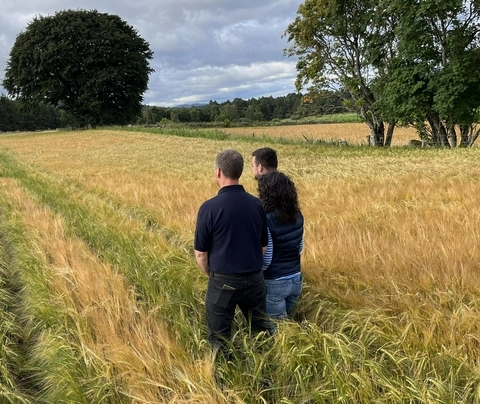
Tackling potentially difficult discussions on family farm succession, being aware of legal rights surrounding farming and family and understand the complexities of related finance and tax planning is not straightforward, especially after the Budget. Now Monitor Farm Scotland has made its innovative succession play available online, so anyone can see how these sensitive topics might be tackled by a farming family and their professional advisers.
Based on real experience and practical scenarios, Monitor Farm Scotland, with Johnston Carmichael, Virgin Money and Shepherd and Wedderburn, staged three live performances earlier this year at Inverurie, Stirling and St Boswells, bringing issues to the fore, including coping with recent Inheritance Tax changes. Now the play is available to watch online on-demand via the Monitor Farm YouTube channel.
‘Succession, Finance, Legal Rights and Tax Planning: A Play’ takes the format of a round-the-table discussion with a banker, solicitor and accountant with a farming family in the middle. Watch online to see how the discussions go, the key topics and how the advice from different professionals impacts on the farming family at the centre of discussion.
Professionals in the 35-minute film, introduced by Monitor Farm Scotland, include Petra Grunenberg, solicitor and rural team partner at Shepherd and Wedderburn and a rural law accredited specialist; Graham Leith, chartered accountant with Johnston Carmichael; plus Rona Jordan, agricultural business manager with Virgin Money.
Jenn Stewart, partner and head of rural at Johnston Carmichael said: “The film gives the opportunity to see the issues that arise when considering a succession plan, acted out in a family setting.”
Shepherd and Wedderburn’s Petra Grunenberg added: “The aim was to allow real time questions and answers in a less formal setting. This will hopefully make it easier to relate to the subjects being discussed, which are often sensitive issues to deal with.”
Rona Jordan from Virgin Money said: “Role playing brought the issues to life more vividly and made the process more real, rather than technical and abstract. It gives an idea of some of the day-to-day conversations we have with our faming clients and the various scenarios to be considered.”
Attendees at a packed performance at Thainstone said the event was very useful. Belinda Muir from Maud, Aberdeenshire, said: “Having a succession discussion acted by professionals who knew their subject well made it sound and feel real. It was easy to understand the main points at a difficult time for farming. Succession will be something we will discuss around our kitchen table.”
Comments from other attendees included: “Get the ball rolling regardless of the situation you are in – have the conversations and make a plan. Tax is unavoidable.” Another said their takeaway was: “Have family meetings. It is important to talk and make plans for the future.”
The meetings also saw Johnston Carmichael’s private client tax team give a topical update, summarising key areas relevant to succession. This session, presented by Nicola Sargeant, is also now available to watch online, covering everything from IHT to partnerships to pensions.
Beth Alexander, Monitor Farm Scotland manager, added: “A play is a different approach to this issue, and watching it should give people encouragement to discuss money, legal and accountancy topics.
“Succession is such a critical issue, especially now, and one which people can find difficult. We hope making this practical approach to it available online will be useful for everyone.”
Watch the succession play here: https://youtu.be/ynH2YLvMOcM?si=x3alwiSJIa5Xpos8
Watch the taxation update here: https://youtu.be/DVlLZ25yWOw?si=mj4GYtDC4uuCdE8c

On Friday 28 February 2025, 36 members of the Stirlingshire farming community came along to Blairfad Farm, Balfron Station for the Monitor Farm Winter meeting.
The Duncan family gave an update on the farming enterprise at both Lands of Drumhead and Blairfad.
The Duncans’ are keen to improve their grazing output and have been working with Graeme Lofthouse and the Monitor Farm management group to address this. While they have started to improve the farm’s pH levels and begun a reseeding programme, they are keen to go faster.
Meeting attendees discussed the approach with Graeme and the Duncan’s as they plan how to do it without compromising the existing farming operation and breaking the bank in one go. The discussion will include working out the cost-benefit of improving grass, and setting and achieving production targets.

The value in understanding a farm’s figures was discussed with Emily from Forrit Consultancy, whose session on planning for profit will included looking at the Duncans’ options for selling their store calves. She will also spoke about finding the opportunities within every enterprise on the farm, Key Performance Indicators and setting targets.
After lunch, Emily and Graeme held a mini Body Condition Scoring (BCS) workshop on the farm’s new Cheviot ewes. Latest Monitor Farm-funded research shows that a BCS check pre-lambing, ensuring ewes are in the appropriate condition, means lambs receive optimum nutrition for robust growth and development.
Crop nutrition plans and profitability came under scrutiny at the February meeting of the Banff and Buchan Monitor Farm, where Scottish Agronomy’s Zach Reilly and Donald Paterson led a crop walk across the farm and discussed its arable performance.
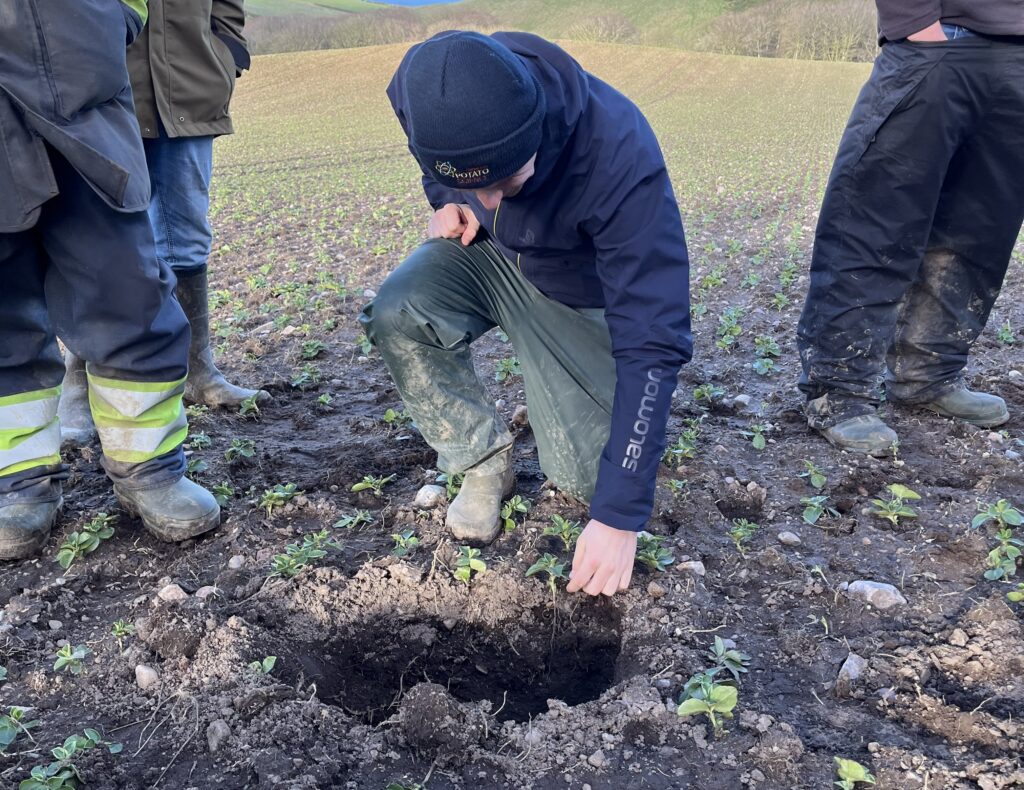
Farmers attending the meeting at Sauchentree, New Aberdour, heard how the crop rotation had changed when Monitor Farmer Bruce Irvine had moved from being organic to conventional farming; last year the farm grew winter wheat for the first time, and he has introduced winter field beans this year.
Read the report here.
With unpredictable weather patterns, livestock outwintering systems have undergone stress tests and challenges the last number of years. Sowing has been delayed by many farmers following slow, wet and cold springs, and mild wet winters have left producers looking for an alternative plan for forage crops.
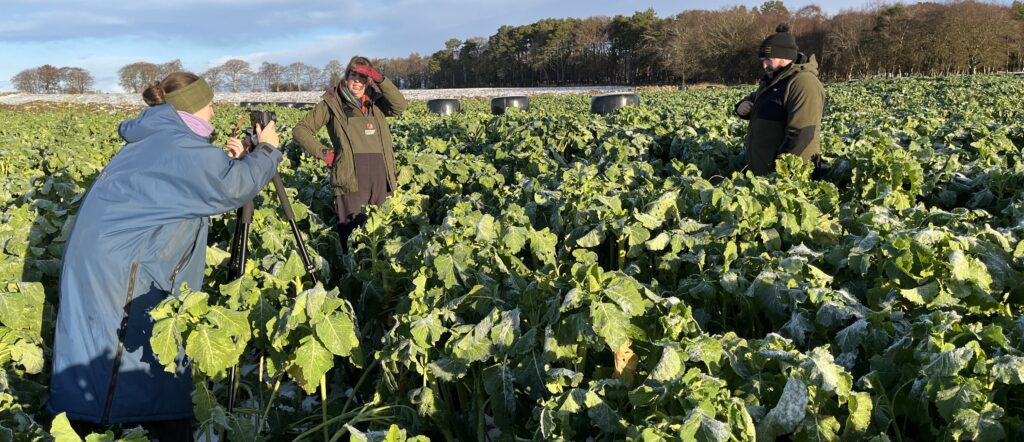
Four members from the Deeside Monitor Farm management group have been sharing their experiences of growing forage crops and outwintering systems. Facilitated by Kirsten Williams, SAC Consulting senior sheep and beef consultant, they are sharing their experiences of how they plan for winter, build resilience into their systems and manage their crops in a challenging climate.
The project is looking at managing and utilising various wintering systems for livestock. It includes monitoring throughout crop growing, yield calculations, crop analysis, and feed allocation calculations. Stock performance will be monitored and full costings of each individual crop and wintering system will be made.
The four farms involved with videos introducing them are:
-Duncan and Claire Morrison, Meikle Maldron, Torphins – Monitor Farmers, who will be building on their outwintering experience through managing deferred and bale grazing as well as kale over winter for their cattle.
-Robert Marshall, Kincraigie Farms, Lumphanan – growing hybrid rape and a hybrid rape and yellow swede mix which will be grazed overwinter by his spring-calving cows and in-calf heifers, with baled silage sited in one field pre grazing.
-Jonny Stewart, Mains of Balfour, Rashenlochy Farm, Drumoak – growing fodder beet and swedes for outwintering sucker cows behind an electric fence, with an arable stubble backrun and hay.
Alex Stephen, Inch of Arnhall, Edzell – a dairy and sheep farmer, Alex is growing fodder beet for ewes to reduce concentrate use pre-lambing, a forage brassica mix for grazing lambs, and stubble turnips for grazing in November onwards with dairy cross stirks.
SAC Consulting’s Kirsten Williams said: “With the unpredictable climate, and different types and classes of soil in Scotland, not every producer can manage outwintering systems. The four farms we are following have various outwintering systems on different soil types, altitude, and classes of stock, with the main driver to use the land asset and reduce the cost of wintering, while maintaining high welfare and nutrition of the animals.
Kirsten added: “There is huge potential for outwintering systems for livestock in the North East. They offer numerous benefits in that they can reduce the cost of winter feeding and the requirement for housing and straw use, while enhancing the production per hectare from the farm and allowing for nutrient cycling from the animal to the soil. The unpredictable weather patterns do give the systems a challenge, meaning having a contingency plan and careful planning of the site.” Peter Beattie, Monitor Farm regional adviser said: “These farmers have experience of outwintering and forage crops already, but this project will bring more detail and discussion to the topic. It will look at all of the pros and cons, and provide farmers across the North East with a good idea of what might be possible, practical and cost effective on their farms
High feed prices made Deeside Monitor Farmers Duncan and Claire Morrison question their bull beef finishing system, and led to trialling finishing them at grass last summer; the final results have now been released.
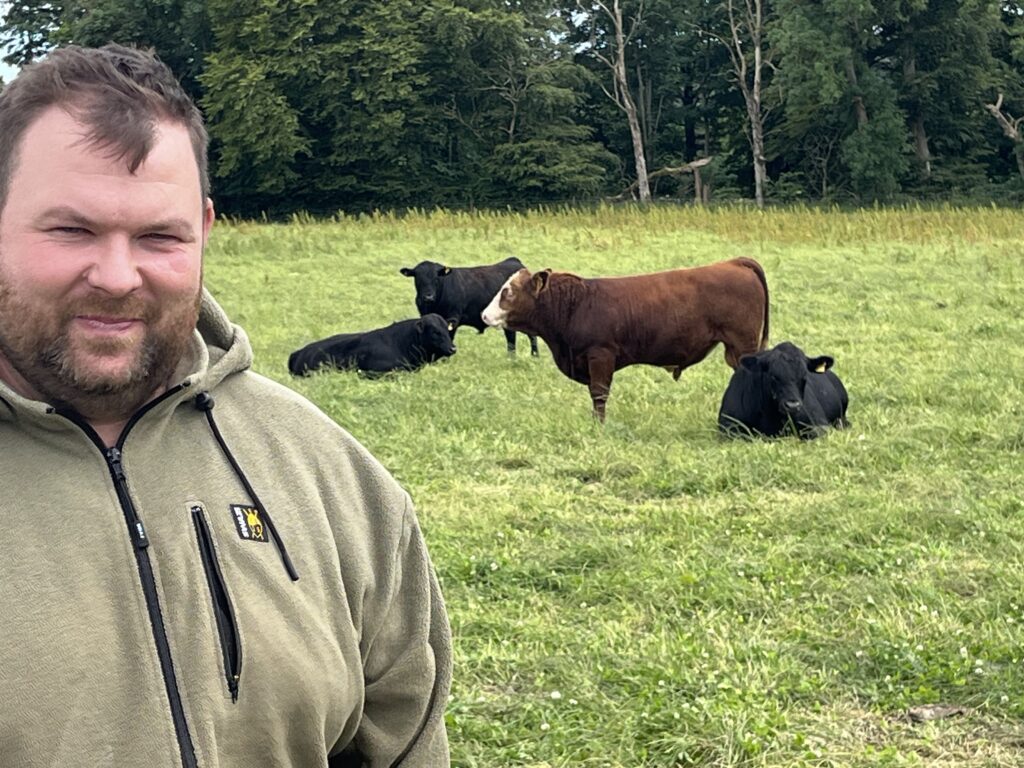
“We got the idea from our breeding bulls, which we bring to sale off grass,” says Duncan, who farms with Claire at Meikle Maldron near Banchory. “They do really well, and the few which don’t make breeding spec have finished at a good weight and before the 16-month deadline,” he says.
Read the full press report with figures and next steps here.
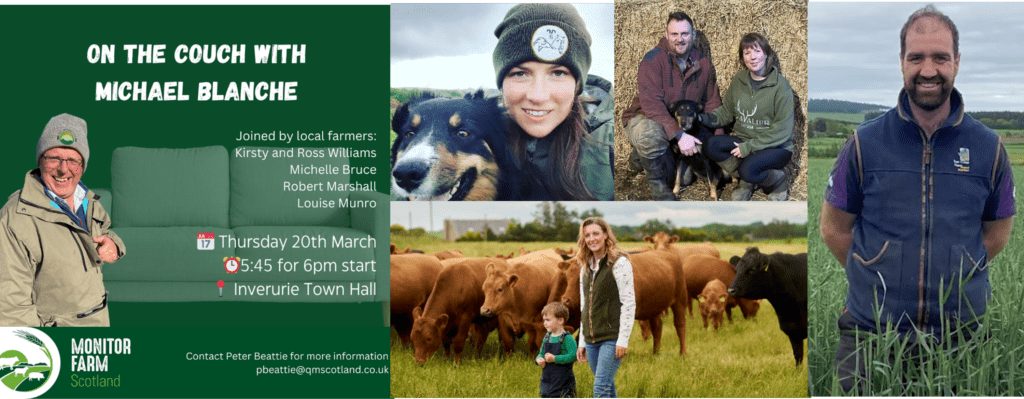
The North East is a hotspot for young, entrepreneurial farmers, typified by Duncan and Claire Morrison, the Deeside Monitor Farmers. Recognising this, the next Deeside Monitor Farm meeting is a forward-looking evening featuring a panel of farmers who are chasing and creating a positive future.
Open to everyone, whatever their age, ‘On the Couch with Michael Blanche’, host of The Pasture Pod, will be held on Thursday 20 March from 5.45-8pm at Inverurie Town Hall. Food provided.
Read more about the case study with a focus on colostrum quality and failure of transfer of passive immunity. This was a joint project with The Stewartry Veterinary Centre and The University of Glasgow. Funded by Monitor Farm Scotland and Livestock Health Scotland.
At the half-way point of the current four-year programme, Monitor Farm Scotland has drawn together progress, statistics and feedback in a comprehensive midpoint review. It includes updates from all nine Monitor Farms across Scotland and their plans for the next two years.
So far, the nine Scottish Monitor Farms have connected over 1,000 farmers and covered more than 60 topics. The programme has developed collaborative partnerships with 58 organisations, ranging from farmers and agribusinesses to research institutions and vets, demonstrating the power of knowledge exchange to enhance skills and communication across the supply chain.
In the first two years, 48 meetings which are open to all have been held, each attracting an average of 54 attendees; an average of 48% of attendees were under 45 and 27% female. The initiative has held a total of 136 meetings including regular management group meetings for each of the Monitor Farms.
Recent surveys have provided additional proof of the programme’s popularity and positive influence:
- 99% of farmers plan to attend future meetings
- 87% report improved technical knowledge
- 78% say it will improve business decision-making
- 90% of management group members say it has strengthened local collaboration and communication
Beth Alexander, Monitor Farm Scotland programme manager says: “Since launching at AgriScot in November 2022, we have seen thousands of people in farming and agribusiness in person at our events, viewing our online updates and reading our press reports and technical articles.
“It has been fantastic to be part of the in-depth discussions at the nine Monitor Farms and see how each of the businesses is adapting and changing as a result. Our meetings allow for constructive discussions and provide a platform for Monitor Farmers to share real-world insights, supported by data, while influencing policy and public perceptions of farming.
“It offers a supportive, business-focused network that helps shift perspectives and drives change. Few initiatives provide such a unique platform for genuine collaboration, sharing challenges and opportunities for growth in the farming sector.”
The Monitor Farm programme’s remaining two years will focus on ensuring farming businesses are sustainable, not just technically but financially.
Beth adds: “While farming is a way of life, it must also function as a business. Many Monitor Farms have gained significantfinancial insights through the ‘Farmer-Led, Farmer-Driven’ approach, boosting confidence for farmers and their management groups to identify and address business challenges.
“Technology will also play a role, with trials exploring virtual fencing, cow collars, and high-tech boluses to monitor suckler cow health. Additionally, the programme is expanding its digital reach with more videos and a new podcast, ensuring farmers across Scotland have access to tools and insights for business and technical sustainability.”
SAC Consulting Ruminant Nutritionist, Lorna Shaw spent the day with the South Ayrshire Management Group taking them through the practical steps to calculating the nutritional value of fodder beet and how to allocate and feed accordingly. Watch this video guide to find out more!