Four years of change: Monitor Farms look to the future at final meetings
After four years of testing ideas, making changes and sharing the results with their local farming communities, Scotland’s nine Monitor Farms are preparing to host their final meetings of the current programme. The series will begin with the Argyll Monitor Farm on Islay on 25 September and travel across Scotland before concluding in Roxburghshire on 12 November.
The final meetings will focus on what has changed, what has made a difference and where each farming business goes next.
Beth Alexander, Monitor Farm Scotland Programme manager said: “Over the last four years we’ve seen our Monitor Farmers challenge themselves, try new approaches and make changes to their businesses.
“These final meetings are our opportunity to bring that journey together – to look at where each farm started, what has changed and, importantly, what they have learned along the way.
“Whether someone has followed their local Monitor Farm throughout the four years or has never attended a meeting before, I would really encourage them to come along. There should be something in every meeting that gets people talking, questioning and thinking about their own business.
“While these are the final meetings of this Monitor Farm programme, the conversations, relationships and changes it has created will continue well beyond them.”
Monitor Farm Scotland final meeting dates:
Deeside – Wednesday 7 October
South Ayrshire – Wednesday 28 October
Banff and Buchan – Friday 30 October
East Lothian – Monday 2 November
Dumfries – Tuesday 3 November
Stirling – Wednesday 4 November
Roxburgh – Thursday 12 November
“Whether someone has followed their local Monitor Farm throughout the four years or has never attended a meeting before, I would really encourage them to come along. There should be something in every meeting that gets people talking, questioning and thinking about their own business.
“While these are the final meetings of this Monitor Farm programme, the conversations, relationships and changes it has created will continue well beyond them.”
Monitor Farm Scotland final meeting dates:
- Argyll – Friday 25 September
- Strathspey – Friday 2 October
- Deeside – Wednesday 7 October
- South Ayrshire – Wednesday 28 October
- Banff and Buchan – Friday 30 October
- East Lothian – Monday 2 November
- Dumfries – Tuesday 3 November
- Stirling – Wednesday 4 November
- Roxburgh – Thursday 12 November
Members of the local farming community attended the meeting to explore the theme “Farm 24 – Farming for the Future” with a key focus on progress made through the Monitor Farm programme while looking ahead to the opportunities and challenges facing the industry.
Please find the full report here –
Around 30 members of the farming community attended the meeting to explore the theme “Making Inputs Count”, with a particular focus on improving the productivity and profitability of lamb finishing systems.
Please find the full report here –
Around 30 members of the farming community attended the meeting to explore how farming businesses can assess opportunities, make informed decisions, and use diversification to build resilience for the future.
Please find the full report here –
Decision making was the key topic at the Deeside Monitor Farm Summer 26 Open Meet.
The five reports here comprehensively cover the issues debated at the meeting on a brilliant day at Duncan and Claire’s Meikle Maldron farm near Banchory.
Duncan and Claire discuss their aims and decisions they’ve made as livestock farmers. Read Duncan and Claire’s report HERE
Keynote speaker, Graham Lofthouse, on how data and information drive decisions. Read Graham’s report HERE
Jamie Leslie, Scholland, Shetland explains the principles of decision making. Read Jamie’s report HERE
Vet Tim Geraghty considers the choices in the management of Johne’s disease Read Tim’s report HERE
Vet Ewan Jamieson highlights sheep worming decisions and planning Read Ewan’s report HERE
“A Good Cow is a Green Cow, and a profitable one”
On May 14th 2026 we held our Winter Open Meeting at Barnbackle Farm, Dumfries. Attendees left recognising that selecting environmentally efficient cows is not a new or separate task it’s already embedded in how they choose their most productive animals: those that are fertile, efficient, durable, and healthy.
The first EnviroBeef Event was one of a kind. What if the cows that perform best in your herd are also the most environmentally efficient? The on farm event showed how the traits you already select for fertility, health, growth, and longevity are the same ones driving sustainability. No new system, just a fresh perspective.
Around 40 members of the farming community attended the meeting.
As the last summer meeting of the programme, we looked at the impact of the grass re-seeding and liming programme, cattle and sheep figures and the aims and direction of travel for Duncan family’s business.
Members of the farming community visited Knockroon Farm to hear how John and David Andrew were implementing Virtual Fencing at Blair Hill, followed by a lamb finishing talk and butchery demonstration before viewing the stock on rotational grazing.
Held on 16 July 2026, the final summer meeting of the Argyllshire Monitor Farm covered, feed planning with Lorna Shaw, re-seeds with Mhairi Dawson Pat Lambert, and rotational and virtual fencing grazing systems with the team at Craigens.
By Beth Alexander, Monitor Farm Programme Manager
The recent spell of warm weather has brought contrasting challenges for livestock farmers across Scotland, with conditions varying significantly depending on local rainfall. While some areas have continued to receive enough moisture to maintain grass growth, others are feeling the effects of prolonged dry conditions.
Across the Monitor Farms in Scotland we have seen big differences in rainfall and therefore grass growth. The Roxburgh Monitor Farm near Morebattle has experienced limited rainfall of 86.4mm since 23rd May 2026 which combined with high temperatures has slowed grass growth considerably. This has become a seasonal pattern for Monitor Farmer, Robert Wilson who has adapted his system to leave taller covers earlier in the season in response to prolonged dry periods. Nearby farms that entered the summer with lower grass covers are seeing grazing supplies tighten, making careful grass budgeting and grazing management increasingly important. Borders farmers have expressed concern regarding winter feedstock but Robert hopes to overcome this using cover crops if he finds a shortfall nearer to harvest.
By contrast, much of Aberdeenshire has benefited from more favourable rainfall, leaving many farms with strong grass covers and good grazing availability despite the warmer conditions. The Deeside Monitor Farm at Torphins, Duncan and Claire Morrison, have seen approximately 145mm of rainfall in the same time period. Grass growth has been strong with good yields of silage but the hot weather is beginning to slow grass growth now. Rotational grazing is fundamental to the Morrison’s system. In response to the recent drier climate, the Morrison’s have begun to lengthen the rotation and leave taller covers behind the livestock to avoid grass scorching in the sun and retaining more moisture at ground level. This has been a different season to last year for the Torphins area, where September 2025 saw them be one of the driest spots in Europe.
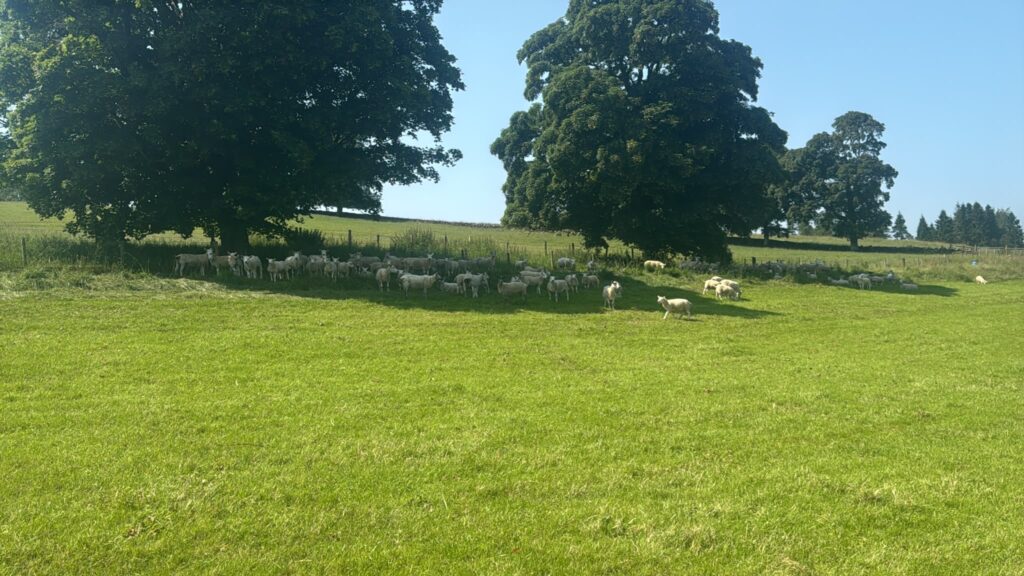
Regardless of grass availability, protecting livestock from heat stress should remain a priority. Providing access to shade or shelter, whether through trees, hedges or trailers in fields can help animals regulate their body temperature and reduce the effects of prolonged heat.
An adequate supply of fresh drinking water is equally important. Farmers should regularly check water flow and trough space – making sure calves can reach the water troughs too – as livestock water demand increases significantly during hot weather. As a guide, daily water requirements can increase to:
- A 700kg lactating suckler cow with calf at foot can drink 105 litres of water a day
- Poppy Frater has some good water supply advice here through the Farm Advisory Service: https://www.fas.scot/article/supplying-water-to-rotationally-grazed-beef-cattle
With weather patterns continuing to vary across Scotland, monitoring both grass growth and livestock condition will be key. Decisions around grazing rotations, supplementary feeding and water provision may need to be tailored to local conditions rather than following a national picture.