
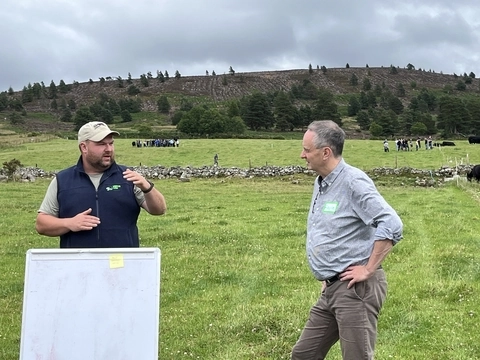
With recent positivity in the beef market and an industry call to keep more cows to maintain Scottish red meat production, suckler producers at the recent Deeside Monitor Farm open meeting discussed options to increase herd size and productivity.
Deeside Monitor Farmers Duncan and Claire Morrison from Meikle Maldron at Torphins near Banchory have recently been successful in obtaining a secure tenancy on a neighbouring unit. The additional 164 acres takes their total area farmed to 770 acres, mainly grassland, across four farms, with 110 acres owned, 430 acres tenanted and the rest seasonal lets. About 260 cows and heifers will be bulled this summer, consisting of pure Aberdeen Angus and Stabilisers plus a commercial herd; now they want to increase cow numbers to 320.
Speaking at the meeting, SAC Consulting senior beef specialist Gavin Hill said that while cow numbers in Scotland had dropped by 11.7% from 2015 to 2024 (a loss of 51,000 cows), some farms have increased cow numbers. Recent cattle prices have been encouraging but confidence is still needed. Economic pressure still dictates decisions, he said.
Now, 56% of Scotland’s suckler cows are kept on only 16% of holdings, with some suckler herds working with 600-900 breeding cows. “With larger breeding numbers, the aim is to spread their overheads over more cows to lower costs per head,” he said.
“In times of challenge there is innovation and adoption of ways to reducing costs. Some farms have worked to better use the scale and scope of the land they farm, such as outwintering on hill and upland areas, using collars to access areas they previously couldn’t graze and outwintering on hard hill areas with additional forage.”
He added that technical improvement will always be an aim, particularly suckler fertility, where numbers reared for every 100 cows put to the bull is still only about 86%. “That is a loss of a potential 14 calves in every 100 cows. However, although we may not have improved calving percentage, it has to be noted that bulling periods are far shorter than some years back.
“Another area to focus on is the use of data – if we are to maximise returns then more monitoring of performance is still needed. It is still concerning how many store cattle are going through the market at a very low weight for their age.”
Leading a discussion about how the Morrisons could increase cow numbers by 60, he said it was important to consider where those replacements should come from.
The future should be in youthful cows, so the focus should be on heifer replacements, he said. However, they need to fit into the Morrisons’ ethos. They breed for maternal traits and have a short bulling period of six to seven weeks, so current selected replacements are similar ages, come from the most fertile females in the herd, must achieve more than 1kg DLWG and have a good pelvic score. Gavin warned that buying replacements from out with the herd comes at a large capital and potential health cost.
However, cattle vet Tim Geraghty explained that increasing herd size quickly using only home-bred heifers could be challenging on top of maintaining replacement rates for older cows. “Herd expansion puts pressure on selection – a farmer may need to hold back heifers for replacements that are sub optimal, and the choice between retaining the best heifers versus selling these for the most money is a cash flow pressure known to all farmers!”
He discussed the pros and cons of two other potential options for the Morrisons; buying in heifers to allow rapid expansion, but with cash implications and health risks, or using AI and sexed semen to increase homebred females available for selection. Using sexed semen is a realistic option now Duncan has completed an AI course, and so both synchronized fixed time programmes, or using AI to naturally observed heats, could be used.
Also speaking at the meeting, breeder Neil McGowan from Incheoch Farm in Glenisla described ‘The Ultimate Cow’. She had to be fertile and able to calve at two years old and again at three, which could often be a challenge as the heifer is still growing while rearing a first calf.
“She needs to be producing calves regularly, ideally at around 365 days, to calve without assistance and to be fun to be around, so a good temperament, with good feet, good teats and udder.
“Recording these cow performance indicators and selecting from them is critical. In addition, the ultimate cow needs to fit into the environment of the farm, be low management – so in the case of the Morrisons, a cow that calves easily, keeps condition through winter and thrives in a low input system – and deliver what the market demands.”
Monitor Farm regional adviser Peter Beattie added: “I was delighted to hear so much positivity about growing suckler herds from the Morrisons, the speakers and attendees at the meeting. It was a practical, productive meeting, full of optimism and discussion.”
Farm technology has the potential to improve productivity, profitability and sustainability of this and other Highland farms. Three technologies were on display at the July Open meet, covering grassland management, dock control and virtual fencing.
Critical Mass, Breeding Replacements, Herd Health and ‘The Ultimate Cow’ were up for discussion at July’s Deeside Monitor Farm Open Meet in July 2025.
Duncan and Claire Morrison were joined at Meikle Maldron by consultant Gavin Hill, SAC, vet Tim Geraghty and farmer Neil MacGowan, Incheoch Farm. This report summarises the key points in growing a successful suckler herd.
John Ritchie, Montalt Farm, and Iain Chapman, Farmlay MD discuss time and efficiency at the Banff & Buchan Monitor Farm Summer Open Meeting in June 2025.
Making a success of re-seeds, lamb weaning and virtual fencing
On Friday 11 July 2025, 32 members of the Stirlingshire farming community came along to Lands of Drumhead Farm, Balfron Station, for the Monitor Farm Summer Open meeting.
Monitor Farmers, the Duncan’s, gave an update as to what had been happening on the farm including using virtual fencing for the 25 cows at Inveruglas.
The Duncan family want to produce more kilos from grass. The attendees discussed the re-seed with the Duncan family, Graham Lofthouse (Farm Advisor), and Pat Lambert (Watsons Seeds).
The Management Group wanted to focus on how to wean lambs successfully. Emily Grant has been advising the Duncan family on how to increase farm profits.
Don’t Fence Me In!
On Friday 9 July 2025, 37 members of the South Ayrshire farming community came along to Knockroon Farm, Crosshill, for the Monitor Farm Summer Open meeting.
Monitor Farmers John and David Andrew gave an update on what has been happening on farm, including very positive feedback on being part of the Virtual Fencing project with 25 heifers grazing on an under-utilised area of Blair hill.
Attendees had the opportunity to hear from the Moredun Research Institute and explore the Mobile Laboratory. Dr Eilidh Geddes and Dr Sarah Thomson, used the lab to demonstrate how to do a faecal egg count with farmers bringing their own samples along for testing.
John Ritchie of Montault Farm discussed the process and infrastructure to set up a rotational grazing on you farm, demonstrated by showing the system that had been set up at Knockroon Farm with his practical support.
Around 36 members of the farming community attended the meeting on 12 June 2025.
Community is at the heart of the Argyllshire Monitor Farm, and we were delighted that group member Ewan Findlay extended an invitation to visit his farm – Daill, Bridgend, Islay.
Monitor Framer Craig Archibald then showed the group how well the virtual fencing project was going with 25 suckler cows on rough grazing previously never used by cattle.
at the Banff & Buchan Monitor Farm Open Meeting
The Summer 25 Banff and Buchan Open Meeting on June 6th 2025 began with Michael Blanche, Perthshire livestock farmer and Pasture Pod host, who suggested that we should view time in a clearer way. Read below the press article covering Michael’s 5 ‘P’s of time management.
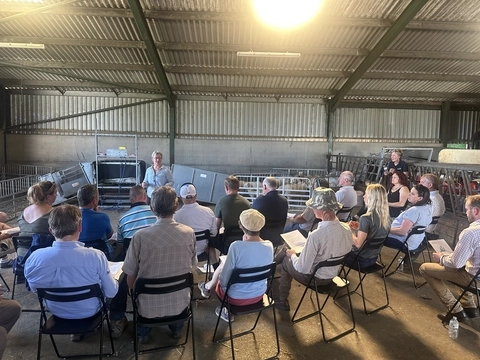
Weaning lambs should be a more considered decision rather than done on a set date, with pasture quality and quantity, weight and body condition score targets and potential markets all being taken into account to drive profitability and efficiency.
Visitors at the Stirlingshire Monitor Farm summer meeting discussed the options with Emily Grant, independent sheep, cattle and grazing consultant.
Emily said that weaning was a time when production focus is moving away from ewes lactating towards lambs starting to grow. “It means being able to prioritise high quality pasture to allow lambs to grow on and, if needed, a bit of time for ewes to put condition back on after lactation has finished. Lactation requires additional energy over maintenance, peak lactation (when lambs are around three weeks old) is when the ewe has her highest energy demand; this can almost treble before falling as lactation declines.”
She said pasture quality and quantity should be a priority for weaned lambs. “Ewe milk is high in energy at 12-13ME, so if you want lambs to continue to grow well it’s important they have highly digestible pasture. This is fundamental as lambs have a relatively small rumen comparable to their size which develops over weeks three to eight of their life before becoming fully functional.”
Consideration of weaning weights is important, she added. “To hit targets, you should ideally be weaning twins at 30kg plus and single lambs at about 35kg plus at about 90 days or thereabouts. Each increase in 1kg lamb wean weight reduces days to slaughter by one week.
“Ideally, ewes should be weaned at BCS 3 which is your target to take into tupping. They can then be on a maintenance diet so you can start to shut down their requirement for high quality grass. In effect, pulling them away from competing with lambs for that pasture.”
Being aware of your farm’s mineral status was important, she said. “For instance, cobalt is deficient across quite a lot of Scotland. Even where it is a bit marginal, cobalt levels will vary between the seasons, so some years it may be fine and others it’s not, but be aware of it as it is a production-limiting deficiency.”
She added that worms and parasites could be a challenge and potentially impact performance at weaning. “You really want them to keep growing to get them marketed as soon as you can and ideally off pasture.”

Thinking about time and how to best manage it could be the key to making more progress, reducing stress and achieving key goals on-farm and in business.
Speaking at the recent Banff and Buchan Monitor Farm meeting at Sauchentree near Fraserburgh, Aberdeenshire, farmer and podcaster Michael Blanche discussed how he had addressed the ‘chaos’ in his own farming enterprise by thinking about time in five ‘P’ steps.
“I am a recovering chaotic person!” he told the meeting. “I used to spend a huge amount of time looking for stuff. I’m a first-generation farmer, and on a limited duration tenancy, so I wanted to do a lot, but I knew I only had a limited time to achieve that.” He said there are five key steps – all beginning with the letter P – to making better use of time.
P1 – Perspective
Make a grid with ten columns across and nine rows down so you have 90 boxes. “Each box represents a year of your life if you are lucky. Shade in up to your age; what’s left unshaded is the time you have left to achieve what you want.
“This is a really good way to look at how much time you realistically have left – it helps to give some perspective and can help you look at things differently. People avoid thinking about this but it’s actually a positive thing.
“In my case, I know exactly how much time I have left on the farm which has really focussed my mind. I know I must tackle my weaknesses with time really aggressively to be any good as a farmer and to make the best of it.”
P2 – Purpose
Think about what you really want to do or achieve in that time, he said. “If you are going to use time properly, you need to know where you are going. What is your purpose?
“If your ladder is up against the wrong wall, every step is taking you to the wrong place, so think about what you want.”
P3 – Priorities
Knowing what your purpose is will help define your priorities – and to know what to say ‘no’ to, he said.
“There is a story about someone asking businessman Warren Buffet about how to deal with being overwhelmed. His answer was to write down all your priorities in life from one to 25 and put them in order of importance to you.
“Then, go to number six and score it out, and score everything below it out too; they might be things you like, but they will take up your time and they are not a priority. The top five are your priorities.”
Michael acknowledged that it can be difficult to stick to those priorities, especially if they are not shared by others. “In that sort of situation, it can be really helpful to do some root cause analysis about it – so ask yourself why something hasn’t worked or been your priority.”
He said that drilling down into something by asking yourself ‘why didn’t I do the task or why didn’t it happen’, then taking the answer and asking why again, and then repeating this for the next few answers usually results in realising that it’s something as simple as not putting it in a diary or sharing your plans.
Writing a to-do list every morning also helps to focus attention and had been helpful in making sure he stuck to his priorities, he said.
P4 – Patterns
“People often want to solve their time management issues but find it hard; it is usually because they are stuck in a pattern. For instance, you will generally know who will be early or late to a meeting, first to plant their crops or last to plough. Breaking negative patterns is important for managing time.”
However, it’s often difficult to change something which is a pattern, and he said people could often be unwilling to address it. “Before you want to change you often have to be very unhappy with the current situation. Recognising that you need or want to change is really good.”
He said that while changing patterns was often hard, it is possible to coach yourself to do it. Rather than berating yourself for doing or not doing something, it was better to take a more positive approach. “Think to yourself ‘yes, well I have done that, but how could I have done it differently or better?’ That positive self-talk can be very helpful in breaking the pattern.”
P5 – Processes
Thinking about how farming and business operations could be more time efficient usually comes down to recognising where time is wasted, which can be due to the way things have evolved, he said.
“People often wince when the word efficiency is mentioned, and I did too, but I’ve changed my mind about it, and it’s a good way of finding more time to tackle your priorities.
“This Monitor Farm is a case in point, as at lambing, the team lambed in two sheds quite a distance apart. Simply by clearing out a shed closer to the main lambing shed and thus cutting the distance for walking back and forth Bruce [Irvine, the Monitor Farmer] estimated a saving of 1 hour 20 minutes a day for all the lambing team. Over a month that’s a total saving of 40 hours.”
Michael said that while many meetings focus on technical efficiency such as feed or animal health, these were only a point in time. “There is a huge amount of time being wasted on farm. Farmers should really think of themselves as process engineers; how can you design a process – and stick to it – that will be efficient?
“Saving 15 minutes a day, for instance, might not seem much, but over 365 days it’s more than 90 hours, or two weeks of work for ‘normal’ people. There are hundreds of processes on farm, improving the efficiency of each would add up to a saving far greater than 15 minutes a day. We will probably all find something to fill that time with, but it’s time that you could be adding value to your business.
“The main thing from all of this is to think about time and how you are using it. We usually don’t recognise it or respect it, but it’s a wholly positive thing when you recognise it is limited – it makes you master the things you want to do.”