
The Irvine Family have grown their business at Sauchentree for nearly 250 years. There’s been rapid growth over the last 36 months and Bruce has established a new 32,000 laying hen unit.
Enterprise costings, farming opportunities, banking and entrepreneurship have all featured in discussions within the Banff &
Buchan Monitor Farm Management Group.
The presenters at this final Summer Open Meeting brought together these themes under the title,
‘How to Grow Your (Farm) Business’.
Read the report here!
With this summer’s seed orders in mind, farmers can use a new in-depth report on overwintering forage crops to help make drilling decisions. The Monitor Farm Scotland and SAC Consulting practical guide covers everything from cost of production and yield to nutritional analysis – and found that protein levels in some crops far exceeded traditional book values.
Carried out across four North-east Scotland farms, the project ‘Maximising the potential of forage crops in a challenging climate’ looked in-depth at 10 forage crops, from establishment to feeding performance. Read the press release here.
A process – n. a series of actions or steps taken in order to achieve a particular end.
Calum and Hamish Smith will discuss how the right processes bring confidence to their decision making as they gradually succeed their parents, Malcolm and Sammie on their Highland livestock farm.
Bull choices, data for decision making, EFA in practice and farm business planning are on the menu at the Strathspey Monitor Farm Summer Open Meeting at Auchernack, Grantown on Spey on Wednesday 3rd June, from 4.30pm.
Find out more and sign up
Like Bruce Irvine, the Banff and Buchan Monitor Farmer, many farmers and others have been asking ‘How do I grow my business?’
To answer this question, the Monitor Farm Open Meeting at Sauchentree Farm, Fraserburgh, from 12.45pm on Friday 29th May, brings together seven dynamic presenters, with their suggestions.
Find out more and book your place
Improving herd efficiency and profitability through data-driven decision-making.
While many farmers collect detailed performance data, translating that information into confident, financially robust breeding and management decisions remains a challenge.
Monitor Farm Scotland is a four-year programme funded by the Scottish Government and managed by QMS and AHDB. With nine Monitor Farms located across Scotland, the initiative uses real commercial farms to test new approaches, share knowledge, and improve productivity, profitability and sustainability across the sector.
SAC Consulting has been working with Monitor Farm Scotland since it began and recently collaborated with them on the challenge of using the right data to make the right decisions for the benefit of farm businesses.
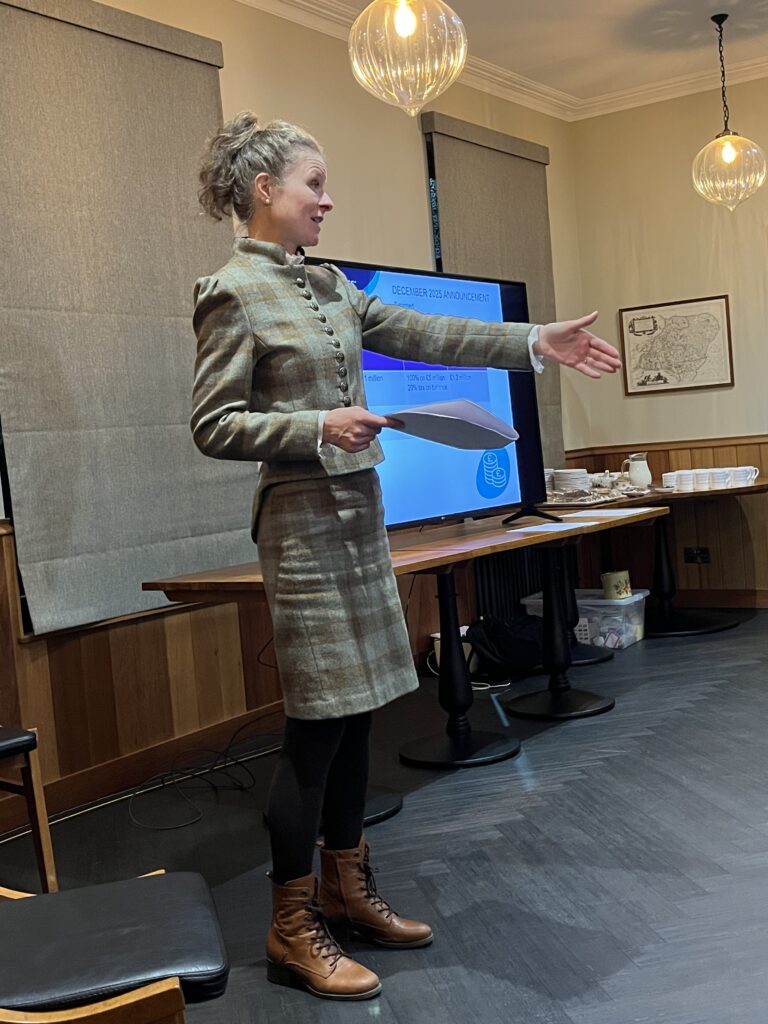
With M2Accountants and Brodies LLP at the Saplinbrae, Mintlaw, Feb 2026
A thoughtful approach to lambing and a disciplined process throughout it has seen a marked improvement in flock performance at the Banff and Buchan Monitor Farm.
Monitor Farmer Bruce Irvine’s 400 mainly Highlander ewes lamb outside during the day, coming in at night, with vet students and family and friends assisting. His aim is to ensure the lambs’ immune system is never compromised, keeping them as healthy as possible so they perform well.
As a result, losses from scanning to weaning at Sauchentree, near Fraserburgh, have fallen significantly, from the Scottish flock average of 15% to less than 7%. Better lamb health has also meant they finished earlier with less supplementary feed; in the first year it was 10t less, saving more than £1,600.
A range of tactics have helped boost lamb survival and performance, with a team meeting at the start of lambing being a crucial part of the whole approach. That’s when vet consultant Tim Geraghty and farm vet Alison Taylor from Buchan Vets spend half a day with everyone involved in the lambing, discussing, demonstrating and getting lambers to practice key skills. It means everyone knows what needs to be done and how, with Bruce adding that team members are often more accepting of vet instructions than if he were to tell them.
Tim says there is a temptation to think everyone, and especially vet or agri students, will be familiar with lambing and tasks such as stomach tubing, but it’s not always the case.
He says: “It’s dangerous to assume everyone will know. You need to make it easy for people to say they are not 100% sure, and that they won’t be judged for saying that. Part of our time on the visit is spent ensuring everyone is confident about tasks such as stomach tubing, and to make it the default that everyone does it in the same way.”
The discussion also covers biosecurity and personal hygiene, as keeping wellies and clothing clean can make a massive difference, says Tim.
“It’s normal that on a mixed farm your wellies and leggings or overalls might be a bit dirty or muddy, but during lambing you are dealing with very high risk baby lambs who are trying to develop their immunity in a very busy area.
“Having clean hands, using gloves and having clean leggings can make a massive difference. Set the bar that the lambing shed will be a clean place. If you set out with clean leggings, you are likely to wash them down if you get some lamb skitter on them, but if you start with dirty leggings they usually just get dirtier and you are less likely to notice and can pose a huge infection risk.”
At Sauchentree, everyone power washes their leggings and boots four times a day, with disinfectant foot dips in every shed.
Bruce has also equipped his lambing sheds with a basic ‘lambing kitchen’ to make cleanliness easy. A sink, kettle and paper towels mean it’s quick and easy to clean equipment such as stomach tubes between every use. A working fridge also allows colostrum to be kept at the right temperature to avoid any bacterial growth which could negatively affect lambs.
“The lambing kitchen means we are not having to run to the house all the time. It makes doing things straightforward – it’s easy for folk to do the right thing.”
Last year he also stopped using one of his sheds for lambing, despite it being well equipped, choosing to instead move the operation into two adjacent sheds. “Our cows calve outside now, so we had a free shed and I was also fed-up of moving everything out of the other shed for lambing.
“It has made a big difference. I didn’t think about the distance at the time, but going between the sheds nine or 10 times a day just added to the tiredness.”
He has also started housing sick lambs and ewes in a separate building until they are better, which has stopped them spreading bugs to the healthy ewes and lambs.
Even so, Tim adds a cautionary note: “These poorly lambs will be excreting millions of bugs, and when you are nursing them, you have to be very aware of that, as you can very easily spread it. Your responsibility is to the whole flock, so even if you save one lamb, if you infect another 20 or 30 that is not a gain.
“Every time you kneel down in the sick lamb pen you will pick up their bugs, and can potentially carry them back to the main, healthy flock. It’s worth raising the awareness of how dangerous the sick and pet pens can be to other lambs.” Biosecurity and cleanliness between the main flock and these pens is critical, he says.
At Sauchentree, all pens are cleaned out and disinfected after every ewe. A spray disinfectant is applied to the wooden pens and floor via a garden hand pump, and a lime-based powder is spread on the floor before bedding down. Pens are bedded with wood shavings which also have some anti-bacterial effect, says Bruce. Shavings are bought in bales to make handling easy at lambing.
Bruce has also changed the watering system, with individual buckets being replaced with a piped system using drainpipes with holes cut in them. “It cost very little to do,” he says. This ensures ewes have fresh water at all times, and saves buckets being tipped or lambs getting stuck in them.
Ewes are offered a TMR mix as soon as they have lambed, avoiding the risk of negative energy balance and ensuring they have plenty of colostrum and milk.
Colostrum is one of the key topics covered in the vet meeting, with quantity, quality and quickness being the watchwords. Ensuring every lamb has received enough, preferably within two hours of birth is crucial and so one person each day will take responsibility for colostrum for all lambs.
Bruce has started using clips for tails and castrating lambs, and this has cut joint ill cases. While they take some time to get used to, the farm had just one case last year, he says.
When ewes and lambs are ready for the field, after about 48 hours, they are taken in the trailer, with the area lambs travel in having plenty of shavings as bedding to keep them clean and dry. The trailer is cleaned and disinfected every couple of days to maintain biosecurity.
During a busy lambing Bruce says doing all of this can seem daunting, and there is a labour cost to it. “It takes time, and doing it takes thought and discipline, but it has just become part of the process here. I want to make sure lambs have a good start and that their immune system isn’t compromised at an early stage.”

About the Banff and Buchan Monitor Farm
Sauchentree Farm, at New Aberdour, on the north-east coast of Scotland, is run by Bruce Irvine in partnership with his wife Vicky and his mother. Help at lambing comes from art-lecturer Vicky, his sister and brother-in-law, and their two daughters are starting to get involved in the farm. A new laying hen unit was built last summer.
In total, Bruce farms 263ha (650ac) with cereals, sheep, cattle and hens. He believes the enterprises are as important as each other, with livestock providing fertility for the arable side. Bruce markets lamb and beef through Woodhead Bros, Turriff and ANM at Thainstone. This year, the Irvine family will have been at Sauchentree for 250 years.
With arable financials under close scrutiny this year, using henpen can be a valuable option to reduce costs, but making the most of it requires analysis, planning and prompt action.
Banff and Buchan Monitor Farm host Bruce Irvine has used henpen in the past but having recently added two laying hen units to his business, he will be making greater use of it this year. “I used to buy-in about 700t a year before, but now we are producing about 1,200t a year from our two flocks.”
This spring, he plans to apply it to stubbles before drilling spring barley, to grass and to swede and kale ground. His farm, Sauchentree, is in a Nitrate Vulnerable Zone (NVZ) and on mixed soil types which impacts spreading dates and rates.
Bruce has already had his henpen analysed, a critical step in making best use of it, says Zach Reilly from Grounded Agronomy. “If you know what you’ve got, you can put a value on it and reduce artificial fertiliser application.”
Analysis also highlights that henpen nutrient values vary widely – it is not a standard product, he warns. This is particularly the case for nitrogen (N) availability, which has a big impact on its value. N availability is affected by factors such where and how long it has been stored for, or even the place the analysis sample was taken from and whether it is representative.
Henpen can also be high in phosphate which, with repeat applications, can quickly build up in soil as it isn’t much depleted by crops. “Too much phosphate can lead to induced phosphate deficiency – there is so much that it isn’t plant available, particularly when the soil is acidic, which means crops need a small amount of phosphate to get the plants up and away. It’s a surprisingly common issue on intensive livestock units applying a lot of henpen.”
Bruce will use a local contractor to apply his henpen at a rate of about 5t/ha using a 24m rear-discharge Bunning spreader. With his own henpen to spread now, he has costed out buying a spreader with weigh cells, but it’s expensive. “I’d need to spread about 20,500t to pay for it.”
Zach adds that working out spreading costs is crucial, including haulage, storage, loading and spreading. “I do a lot of valuations for growers wanting to buy henpen. If you can haul and spread it cheaply, it’s a good option – but a lot comes down to the distance it is being hauled.”
Getting the best nutrient – and financial – value means applying it to a growing crop. “The second-best option is applying it to stubbles – it should be incorporated as soon as possible to reduce N losses and crops sown within four to six weeks.
“From a legislative point of view, you can spread henpen after 1 February, after the end of any closed period, but unless you incorporate it very quickly you will lose N. It’s better holding off. It’s a brilliant fertiliser with very little cost, but you do need to use the manure.”
At Sauchentree, he says applying henpen in March at 5t/ha and ploughing down immediately will capture all the available N (27kg/ha based on analysis of the Sauchentree sample) and supply 36kg/ha phosphate and 54.5kg/ha potash. With spring barley needing 130kgN/ha, Bruce can reduce bagged N to just over 100kg/ha.
Bruce says he finds henpen valuable on grass, particularly clover-rich swards. “Red clover really likes the phosphate and it’s not too rich in N compared with ammonium nitrate.
“It’s good to have more henpen to use if we want to, and it will save us money. I think people often don’t realise what’s in muck in terms of nutrients.”
Making the most of hen pen
- – Sample the manure – the standard analysis isn’t standard
- – Be aware of P levels – repeat applications will see P indices rising in a typical rotation
- – Calculate the spreading costs (haulage, storage, loading, spreading) – particularly important if buying-in
- – Maximise nutrient utilisation to increase value – N optimisation is key
Farmers seeking the latest information on how the changes to agricultural property relief (APR) and business property relief (BPR) could affect them and their families are invited to a Monitor Farm Scotland open meeting to hear expert insights and discuss the implications.
The evening meeting on Wednesday 25 February, at Saplinbrae Hotel, Mintlaw, Aberdeenshire, will host Leigh Gould, Brodies LLP partner, a private client lawyer with over 20 years’ experience. She also advises on how to use additional structures for holding and passing on wealth and minimising tax. She has a particular focus on advising clients with land and rural businesses.
Leigh will discuss the implications for farm businesses of recent changes in agricultural property relief (APR) and business property relief (BPR) for Inheritance Tax (IHT) when these are introduced in April 2026. Alongside colleague Georgia Chalmers, Leigh will also cover wills, trusts, partnership or shareholder agreements, and lifetime gifts.
Leigh says: “There have been welcome changes to the proposed new regime for inheritance tax for farm and other business owners. Agricultural property relief (APR) and business property relief (BPR) for IHT will be increased from £1m to £2.5m when it is introduced in April 2026.
“The need to plan for the hand over to the next generation in life or on death remains to be done. The part-reversal of the IHT changes may make this easier to do.’’
If you’d like to understand how the changes to APR and BPR could affect your farm or business, come to this Monitor Farm Scotland meeting, hear Leigh’s insights and quiz her on the night.
Chaired by Michael Murray, director of M2Accountants, this meeting is open to all and starts at 5.45pm with a buffet supper, so booking is essential for catering purposes.
Peter Beattie, Monitor Farm regional adviser says: “This will be a great opportunity to hear the latest information on this topic from an expert dealing with it every day. After Leigh’s presentation, there will be a chance to ask questions and then continue discussions over tea and coffee.”
- Monitor Farm Scotland update on the impact of changes to Inheritance Tax for farm businesses on Wednesday 25 February 5.45-9pm at Saplinbrae Hotel, Mintlaw, AB42 4LP. Buffet supper provided, so booking is essential. Book here:https://IHTwithLeighGould.eventbrite.co.uk
The businesses’ Farm Advisory Service integrated land management plan
highlighted that improved nutritional management and data-driven decision
making at Craigens, the Argyllshire monitor farm, could promote herd
performance and reduce costs of production. Ration and mineral planning, along
with data collection and analysis to improve breeding selection, will help control
feed costs and optimise on-farm efficiency with cattle that suit the system at
Craigens.
The data available on the farm also presented another opportunity to strengthen
selection, increasing overall herd efficiency moving forward, by using more
informed decisions. Data such as cow weight and body condition, alongside calf
performance, can be used to model profitability on an individual basis to assess
which cows are of most value to the herd. This should be considered alongside
other data, such as calving interval, to ensure fertility is maintained.