Don’t Fence Me In!
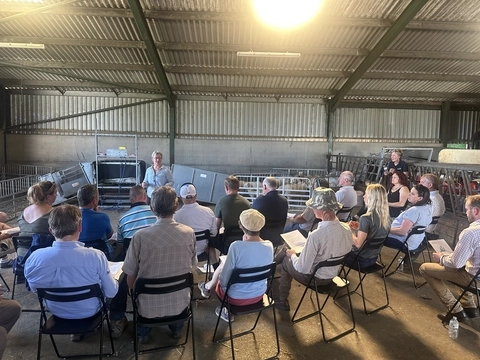
On Friday 9 July 2025, 37 members of the South Ayrshire farming community came along to Knockroon Farm, Crosshill, for the Monitor Farm Summer Open meeting.
Monitor Farmers John and David Andrew gave an update on what has been happening on farm, including very positive feedback on being part of the Virtual Fencing project with 25 heifers grazing on an under-utilised area of Blair hill.
Attendees had the opportunity to hear from the Moredun Research Institute and explore the Mobile Laboratory. Dr Eilidh Geddes and Dr Sarah Thomson, used the lab to demonstrate how to do a faecal egg count with farmers bringing their own samples along for testing.
John Ritchie of Montault Farm discussed the process and infrastructure to set up a rotational grazing on you farm, demonstrated by showing the system that had been set up at Knockroon Farm with his practical support.
Around 36 members of the farming community attended the meeting on 12 June 2025.
Community is at the heart of the Argyllshire Monitor Farm, and we were delighted that group member Ewan Findlay extended an invitation to visit his farm – Daill, Bridgend, Islay.
Monitor Framer Craig Archibald then showed the group how well the virtual fencing project was going with 25 suckler cows on rough grazing previously never used by cattle.
at the Banff & Buchan Monitor Farm Open Meeting
The Summer 25 Banff and Buchan Open Meeting on June 6th 2025 began with Michael Blanche, Perthshire livestock farmer and Pasture Pod host, who suggested that we should view time in a clearer way. Read below the press article covering Michael’s 5 ‘P’s of time management.
Weaning lambs should be a more considered decision rather than done on a set date, with pasture quality and quantity, weight and body condition score targets and potential markets all being taken into account to drive profitability and efficiency.
Visitors at the Stirlingshire Monitor Farm summer meeting discussed the options with Emily Grant, independent sheep, cattle and grazing consultant.
Emily said that weaning was a time when production focus is moving away from ewes lactating towards lambs starting to grow. “It means being able to prioritise high quality pasture to allow lambs to grow on and, if needed, a bit of time for ewes to put condition back on after lactation has finished. Lactation requires additional energy over maintenance, peak lactation (when lambs are around three weeks old) is when the ewe has her highest energy demand; this can almost treble before falling as lactation declines.”
She said pasture quality and quantity should be a priority for weaned lambs. “Ewe milk is high in energy at 12-13ME, so if you want lambs to continue to grow well it’s important they have highly digestible pasture. This is fundamental as lambs have a relatively small rumen comparable to their size which develops over weeks three to eight of their life before becoming fully functional.”
Consideration of weaning weights is important, she added. “To hit targets, you should ideally be weaning twins at 30kg plus and single lambs at about 35kg plus at about 90 days or thereabouts. Each increase in 1kg lamb wean weight reduces days to slaughter by one week.
“Ideally, ewes should be weaned at BCS 3 which is your target to take into tupping. They can then be on a maintenance diet so you can start to shut down their requirement for high quality grass. In effect, pulling them away from competing with lambs for that pasture.”
Being aware of your farm’s mineral status was important, she said. “For instance, cobalt is deficient across quite a lot of Scotland. Even where it is a bit marginal, cobalt levels will vary between the seasons, so some years it may be fine and others it’s not, but be aware of it as it is a production-limiting deficiency.”
She added that worms and parasites could be a challenge and potentially impact performance at weaning. “You really want them to keep growing to get them marketed as soon as you can and ideally off pasture.”

Thinking about time and how to best manage it could be the key to making more progress, reducing stress and achieving key goals on-farm and in business.
Speaking at the recent Banff and Buchan Monitor Farm meeting at Sauchentree near Fraserburgh, Aberdeenshire, farmer and podcaster Michael Blanche discussed how he had addressed the ‘chaos’ in his own farming enterprise by thinking about time in five ‘P’ steps.
“I am a recovering chaotic person!” he told the meeting. “I used to spend a huge amount of time looking for stuff. I’m a first-generation farmer, and on a limited duration tenancy, so I wanted to do a lot, but I knew I only had a limited time to achieve that.” He said there are five key steps – all beginning with the letter P – to making better use of time.
P1 – Perspective
Make a grid with ten columns across and nine rows down so you have 90 boxes. “Each box represents a year of your life if you are lucky. Shade in up to your age; what’s left unshaded is the time you have left to achieve what you want.
“This is a really good way to look at how much time you realistically have left – it helps to give some perspective and can help you look at things differently. People avoid thinking about this but it’s actually a positive thing.
“In my case, I know exactly how much time I have left on the farm which has really focussed my mind. I know I must tackle my weaknesses with time really aggressively to be any good as a farmer and to make the best of it.”
P2 – Purpose
Think about what you really want to do or achieve in that time, he said. “If you are going to use time properly, you need to know where you are going. What is your purpose?
“If your ladder is up against the wrong wall, every step is taking you to the wrong place, so think about what you want.”
P3 – Priorities
Knowing what your purpose is will help define your priorities – and to know what to say ‘no’ to, he said.
“There is a story about someone asking businessman Warren Buffet about how to deal with being overwhelmed. His answer was to write down all your priorities in life from one to 25 and put them in order of importance to you.
“Then, go to number six and score it out, and score everything below it out too; they might be things you like, but they will take up your time and they are not a priority. The top five are your priorities.”
Michael acknowledged that it can be difficult to stick to those priorities, especially if they are not shared by others. “In that sort of situation, it can be really helpful to do some root cause analysis about it – so ask yourself why something hasn’t worked or been your priority.”
He said that drilling down into something by asking yourself ‘why didn’t I do the task or why didn’t it happen’, then taking the answer and asking why again, and then repeating this for the next few answers usually results in realising that it’s something as simple as not putting it in a diary or sharing your plans.
Writing a to-do list every morning also helps to focus attention and had been helpful in making sure he stuck to his priorities, he said.
P4 – Patterns
“People often want to solve their time management issues but find it hard; it is usually because they are stuck in a pattern. For instance, you will generally know who will be early or late to a meeting, first to plant their crops or last to plough. Breaking negative patterns is important for managing time.”
However, it’s often difficult to change something which is a pattern, and he said people could often be unwilling to address it. “Before you want to change you often have to be very unhappy with the current situation. Recognising that you need or want to change is really good.”
He said that while changing patterns was often hard, it is possible to coach yourself to do it. Rather than berating yourself for doing or not doing something, it was better to take a more positive approach. “Think to yourself ‘yes, well I have done that, but how could I have done it differently or better?’ That positive self-talk can be very helpful in breaking the pattern.”
P5 – Processes
Thinking about how farming and business operations could be more time efficient usually comes down to recognising where time is wasted, which can be due to the way things have evolved, he said.
“People often wince when the word efficiency is mentioned, and I did too, but I’ve changed my mind about it, and it’s a good way of finding more time to tackle your priorities.
“This Monitor Farm is a case in point, as at lambing, the team lambed in two sheds quite a distance apart. Simply by clearing out a shed closer to the main lambing shed and thus cutting the distance for walking back and forth Bruce [Irvine, the Monitor Farmer] estimated a saving of 1 hour 20 minutes a day for all the lambing team. Over a month that’s a total saving of 40 hours.”
Michael said that while many meetings focus on technical efficiency such as feed or animal health, these were only a point in time. “There is a huge amount of time being wasted on farm. Farmers should really think of themselves as process engineers; how can you design a process – and stick to it – that will be efficient?
“Saving 15 minutes a day, for instance, might not seem much, but over 365 days it’s more than 90 hours, or two weeks of work for ‘normal’ people. There are hundreds of processes on farm, improving the efficiency of each would add up to a saving far greater than 15 minutes a day. We will probably all find something to fill that time with, but it’s time that you could be adding value to your business.
“The main thing from all of this is to think about time and how you are using it. We usually don’t recognise it or respect it, but it’s a wholly positive thing when you recognise it is limited – it makes you master the things you want to do.”
Innovation is one of the programme’s strengths, and this booklet outlines some of the
research and approaches being trialled on the nine Monitor Farms. It covers work which has
been successfully completed and projects which are ongoing. All are practical and aimed at
improving productivity, profitability and business sustainability for the Monitor Farms involved
and for the wider farming sector though our management and community groups, as well as
press coverage and social media.
Implementing research and innovation can be challenging, and people are at the heart of
adopting and driving forward these innovative approaches. Our main focus of the Monitor Farm Scotland programme is ‘Farmer Led, Farmer Driven.’ This continues to encourage people to innovate and
collaborate to achieve a sustainable, positive future for Scotland’s farming industry.
What’s Inside?
- Innovative Practices: Discover cutting-edge techniques in soil health, crop management, livestock welfare, and sustainable farming.
- Farmer-Led Solutions: Learn from real farmers who are trialling new approaches and sharing their results openly.
- Collaborative Learning: See how peer-to-peer learning and community engagement are driving change on the ground.
- Data-Driven Decisions: Explore how technology and on-farm data are being used to improve productivity and resilience.
Why It Matters
Over the past 21 years, the Monitor Farm initiative has been a driving force for innovation, experimentation, and positive change in our sector. And that spirit is very much alive in the current programme. Today, we’re not just celebrating the strength of our farming community—we’re highlighting the innovation, collaboration, and knowledge-sharing that are helping to shape a more resilient and sustainable future for Scottish agriculture.
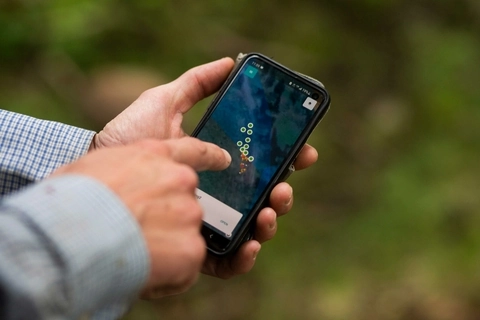
The Monitor Farm Scotland virtual fencing project is well underway on four Monitor Farms, with farmers reporting positive experiences so far, despite some initial scepticism about the technology and how it would work in a commercial situation.
The four farms involved – Argyllshire, South Ayrshire, Stirlingshire and Strathspey – have 25 collars apiece from Norwegian specialist Monil and are testing them in their herds to assess the cost-benefit in a two-year project.
So far, the farms have fitted the solar-powered collars, have trained their cattle to turn away when they hear the collar’s signal for the virtual fence, and are using it to manage their grazing on the uplands and hills. The virtual fence is set using an app; the fence, individual animal location and movement, plus any escapees, are visible in the app. Fences can be moved and any breakouts managed remotely, with notifications sent when cattle don’t move for a certain period.
The Duncan family, Stirlingshire Monitor Farmers, are using the collars on cows on their hill farm at Inveruglas, which runs to 3,000ft and is 30 miles from their home farm. Bruce Duncan says: “We have been quite impressed at being able to locate the cattle and move them remotely. Our aim is to get them to graze in areas they wouldn’t normally go to, and we are also going to see if we can use the cows and virtual fencing to tackle some areas of bracken infestation.”
Islay Monitor Farmer Craig Archibald says he had some initial challenges as his cows were trained on the hill, which meant there was no physical barrier to help with the process, but after cattle were trained, it has been ‘pretty good’. “It’s working well, and I’ve been able to put the cattle on rough ground where they haven’t been before. I’ve also got sheep grazing with them.”
For Strathspey Monitor Farmer Calum Smith, virtual fencing means he can now graze his heifers in 5ha rotational paddocks on a 120ha upland hill. “We did have a mass break-out at one point, but we were able to manage it remotely and get everyone back. The system is like another set of eyes on the cattle, and it offers more reassurance and insight into cow behaviour too.”
On the South Ayrshire Monitor Farm, cattle in the project are grazing areas of their hill which haven’t been eaten by cattle for more than 20 years. John and David Andrew believe this will improve their grazing across their 450ha of hill land at Blair. David adds: “The collars and app make locating cattle much easier – we could spend hours looking for them in the past.”
Coll-based farmer and former Scotland rugby captain Rob Wainwright has been using the system for 18 months and discussed his experience at a Monitor Farm Gathering at the Royal Highland Show. Of the farm’s 1,800ha, only a third was usually grazed, but the collars will mean that has and will continue to change, he said.
The system had allowed them to graze cattle tightly to tackle bracken, to exclude them from environmentally sensitive or dangerous areas, and may allow them to increase cattle numbers. He added that he and his son had been continuing their multi-paddock grazing system while away at the show. “We’ve been managing the cattle from afar, moving them into new paddocks every day.”
Christine Cuthbertson, Monitor Farm Scotland regional advisor who is running the virtual Fencing project, said: “This is a really exciting project, and may transform the business of keeping cows in Scotland’s hills and uplands. We will be assessing the cost-benefit over the next two years and will also be reporting the positives and challenges our four Monitor Farms find with the technology.
“It was great to hear what Rob is doing as he has been using the system for a while, and it’s interesting to hear the changes the Monitor Farms are already planning to make in their businesses, only a few months into this project,” she said.
With grass weeds an increasing problem on farms, the battle for control should be starting now. Visitors at the East Lothian Monitor Farm summer meeting heard how cultural methods should be the mainstays of control, with work beginning now to map the extent of the problem before harvest.
Speaking to attendees at the event, Scottish Agronomy agronomist Stevie Gray said understanding what grass weeds were present on farm and mapping where they were should be done now. “Brome is an increasing problem, and understanding which type of brome or grass weed you have may not seem like a priority. Use the next few weeks before harvest to get out and identify which brome or grass weed species are present on your farm as that will impact what you do next.”
The East Lothian Monitor Farm, at Castleton near North Berwick has an increasing grass weed issue, with farmer Stuart McNicol facing high herbicide costs. Brome has built up on-farm for a variety of reasons, and this is now impacting on crop management decisions.
Stevie said: “Brome is being favoured by the increase in non-inversion tillage as its seeds are no longer being buried; we often find farms several years into a non-inversion tillage system running into problems with grass weed control.
“Sterile brome is the main problem at Castleton, but other farms could have multiple types of brome or blackgrass, and some have different bromes in different areas of their farms.”
He recommends growers use an online Rothamsted Research publication called ‘Which brome is that?’ which is available on the Monitor Farm Scotland website [insert link once uploaded] to help identify what species is on-farm. “It’s a good place to start as brome species can often look similar.”
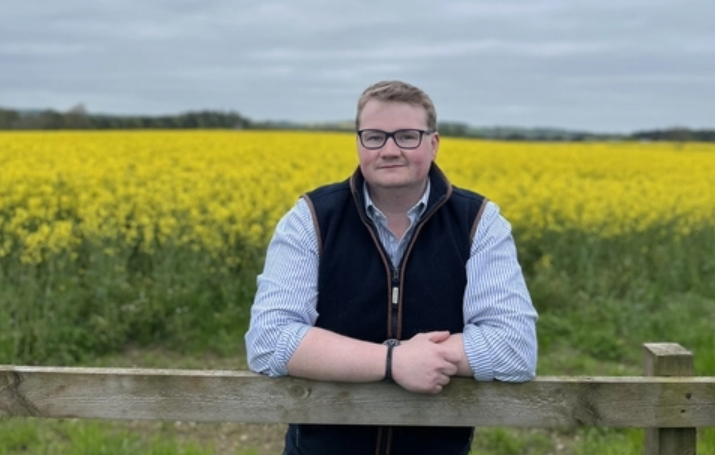
Contract farming agreements could be one way of helping to navigate some of the complications introduced with the Government’s changes to Inheritance Tax.
Jack Frater, agricultural consultant at Edwin Thomson and who is featured in a 13-page Monitor Farm Scotland Q&A Guide to Contract Farming Agreements (CFAs), says they could be a useful option for farmers, and so there may be more opportunities for contractors.
The guide, aimed at helping farmers and contractors understand more about the opportunities and challenges involved with CFAs, was published following a Roxburghshire Monitor Farm panel evening featuring businesses who spoke about their experiences.
While CFAs are a very different approach from tenancies, they give both established contracting businesses and new entrants an opportunity to grow their enterprise, while still allowing farmers (the party with the land) to retain their land and business taxation status, and to be as involved in the business as they would like to be.
Jack, who chaired the meeting, says the subsequent change to IHT has focused people’s minds. “If anything, it has forced conversations that people have been putting off for a long time.
“CFAs are being talked about in this situation, especially if the next generation are not working within the business and are not necessarily looking to take the business on immediately. It means that the older generation can transfer the assets and take a step back but with the idea of keeping business going to ensure the relief remains, or is avoided by transferring over seven years.
“There are some issues that need to be factored in with this though, especially rules around the farmhouse. If the older generation are planning to hand the business over, they can’t then remain in the farmhouse as it can be seen as still benefitting from the asset. Therefore it is imperative that people speak to their accountant and advisor well in advance of making any decision to ensure they are not opening themselves up to further liability.”
The changes to IHT have had no impact on the structure of CFAs, but Jack adds that it has highlighted the importance of having the relevant documentation in place to protect the position of the landowner/farmer.
He is also optimistic about the growing availability of CFAs: “I do think there will be more opportunities for contractors going forward as more land is likely to become available in one form or another.”
Grace Reid, Monitor Farm Scotland programme manager adds: “Contract farming agreements have become an increasingly useful and important part of modern farming set ups. The Q&A Guide is a practical publication featuring people who have in-depth experience of setting up and operating CFAs. It’s helpful start for both farmers and contactors to get the ball rolling and is free to download.”
- The 13-page Q&A guide to Contract Farming Agreements is available to download on the Monitor Farm Scotland website: https://www.monitorfarms.co.uk/wp-content/uploads/2020/10/Contract-farming-QA.pdf
Following the success of its debut season, Field Talk, the podcast from the Monitor Farm Scotland Programme, is back with a brand-new series celebrating ground-breaking on-farm innovation and the expert voices leading change in Scottish agriculture.
Hosted by food and farming vlogger Wallace Currie – aka Rural2Kitchen – the new series continues to shine a light on real Scottish farms and the people driving them forward. This season’s episodes will take a deep dive into projects tackling the big questions in productivity, profitability, and sustainability – with innovation front and centre.
Launching the series is “Virtual Fencing – Opportunity to return suckler cows to the hills”, an episode exploring how virtual fencing technology is being trialled on four Monitor Farms. Wallace is joined by Ann Elinor Aasen from Monil, the tech provider, and livestock systems expert Dr Tony Waterhouse. Together, they explore how the technology could help farmers make better use of grazing, reduce labour, and improve monitoring.
Grace Reid, Monitor Farm Programme Manager, said:
“This series is all about showcasing practical innovation in action – ideas being tested by farmers for farmers. From virtual fencing to genetic testing and everything in between, it’s a chance to share real results, spark new thinking, and support change on the ground.
“We’re excited to bring listeners into conversations around topics such as grazing management, the Deeside Forage Project, identifying profitability markers in cattle, and the role of nutrition planning in tackling issues like pneumonia.
“We’ll also be exploring what maximum sustainable output really looks like on a modern Scottish farm. These are real, relevant issues that farmers are working through – and we’reproud to help share their stories.”
The Monitor Farm Scotland Programme, launched in November 2022 and running until 2026, is managed by Quality Meat Scotland (QMS) with support from AHDB and funding from the Scottish Government’s Knowledge Transfer and Innovation Fund. It is the first of its kind to span four years, giving time and space to properly test and evaluate new approaches.
Listeners can catch up on Field Talk Series 1 – where each episode follows one of Scotland’s nine Monitor Farms – and subscribe for new episodes wherever they get their podcasts, including Spotify. Whether you’re at home, in the lambing shed, or out on the quad, Field Talk is the place to hear directly from farmers and the experts working alongside them.
For more information and updates, visit monitorfarmscotland.co.uk and follow Monitor Farm Scotland on social media.